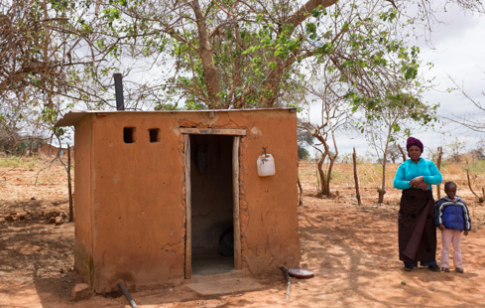
Zâmbia WASH: Vigilância móvel usando DHIS2
The government of Zambia is actively working towards an end to open defecation—a huge challenge for many governments. Akros is supporting the government in this goal through water, sanitation, and hygiene programs that use mobile surveillance technology at the community level. The community level data collection and feedback system, which relies on DHIS2, has demonstrated that over 2.5 million Zambians have gained access to adequate latrines in rural areas since 2014.
Zâmbia em poucas palavras
Zambia is a landlocked, primarily-rural country in sub-Saharan Africa. Of its ten provinces, eight are rural. The population relies on a mixture of construction, agriculture, manufacturing, mining, and other sectors for economic prosperity. However, in spite of recent economic growth, as of the 2013-2014 Demographic Health Survey more than half of the population did not have access to improved sanitation facilities.
O que é WASH?
Water, Sanitation and Hygiene, also called WASH, comprises several interrelated public health concerns such as access to safe water, adequate sanitation, and proper hygiene education. Carefully structured WASH programs can help increase life-expectancy and economic productivity.
Combate à defecação a céu aberto
Open defecation is a huge environmental health issue in developing countries such as Zambia. Defecating in the open, where flies can fly freely between food and feces, increases the risk of diarrhoeal diseases.
In an effort to eliminate open defecation, Akros has supported the Government of Zambia, UNICEF and other development partners to extend a DHIS2-based WASH data collection platform to more than 20,000 villages. This system enables government officials and local chiefs to monitor progress towards the elimination of open defecation in their wards and chiefdoms in real-time. Village-level WASH data has given local chiefs and government officials the ability to follow-up with specific villages that lag behind in the uptake of latrine construction and use—which, for the first time, has led to multiple open defecation free (ODF) districts in Zambia.
O que é Akros?
Akros is an NGO that is experienced in the design and implementation of surveillance systems. Akros supports the implementation of WASH programs in Zambia through low-cost feature phones and innovative feedback mechanisms. Akros supports community-level tracking of latrine construction and uptake across nine of Zambia’s 10 districts. www.akros.com.
Antes de DHIS2
In 2012 UNICEF began making massive investments in Zambia with its Community-led Total Sanitation (CLTS) program, a methodology for mobilizing communities to completely eliminate open defecation (OD). This program, however, depended on paper records to be collected and physically delivered to the district level from the villages. This process could take 6 months or longer and left UNICEF, partners, and the Ministry of Local Government and Housing with stale and unusable data.
Utilizando DHIS2 para WASH
When a Zambian-based consultant introduced the Akros country director to DHIS2, things took a swing in a different direction. DHIS2, or “District Health Information Software”, is a flexible, open source software platform used in more than 40 countries. With the help of dashboards, charts, pivot tables and maps, DHIS2 makes data aggregation and data visualization very easy to create, understand and share. http://www.dhis2.org/
Ampliando DHIS2-WASH de 2013 a 2016
In 2013, Akros implemented its first DHIS2 pilot for the WASH project. Thereafter, the electronic WASH surveillance system was scaled to additional districts with a vision of eliminating OD countrywide. Currently the CLTS project has been implemented in 70 districts using the DHIS2 platform.
Estágio 1: Campeões no nível de base
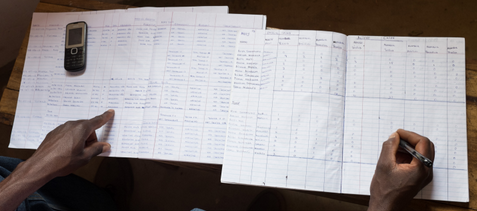
Local stakeholders have played a key role in community level sensitization campaigns that highlight the dangers of OD. With guidance from the Government of Zambia and other partners supporting CLTS, at the village level, volunteers form Sanitation Action Groups (SAGs). These volunteers are equipped with CLTS data collection sheets and collect data on household sanitation, trachoma monitoring, and available access to clean water. Typical survey questions cover areas such as the existence of a latrine in a household and if that latrine is equipped with a lid; access to hand washing and water, soap, or ash; access to bathing shelters; the availability and cleanliness of drinking water, and so forth. SAGs work closely with selected individuals called Community Champions (CCs), who collect data from the SAGs and aggregate and submit the data through their mobile phones to DHIS2.
Etapa 2: relatórios
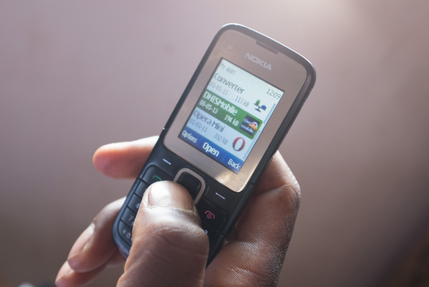
The collected paper-based data is checked by the Community Champions. The data is then submitted via a hand-held device, usually a low-end feature phone that runs a DHIS-J2ME platform, to the next level in the process; the Environmental Health Technicians (EHTs). Thanks to Java technology, the cost of sending data via the DHIS-J2ME platform works out to be ten times cheaper than using standard text messages.
Etapa 3: solução de problemas e verificação de dados
Once a Community Champion submits aggregated data through their mobile phones, this data is made available to all key stakeholders who receive automated HTML performance reports on a given village. The data is then reported to the next level, the village chief, via an Android DHIS2 app.
Etapa 4: dados através dos olhos do chefe
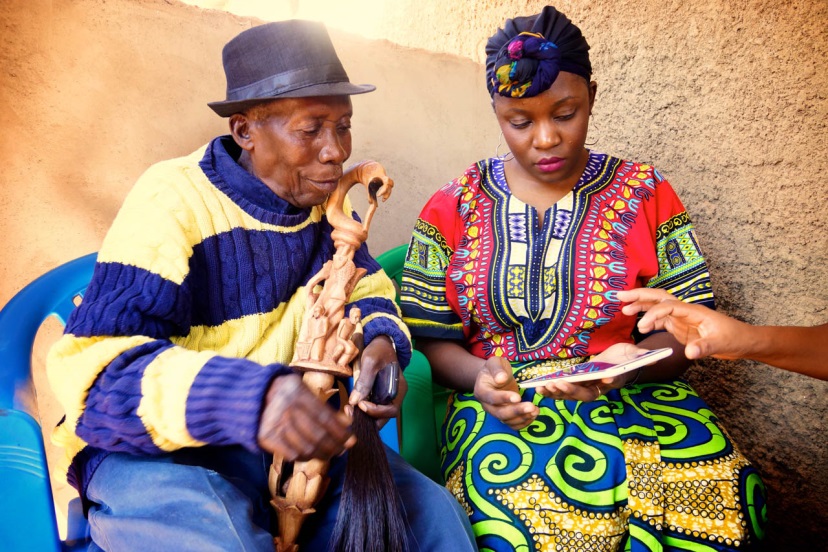
With the help of a Data Viewing Widget on a tablet, referred to as the “Chief App”, the village chief is able to look at the data that his advisors have gathered and make decisions based on what he sees. The chief holds his headmen accountable for any irregularities that could reduce his influence or impinge his reputation. The chief may at times carry out sanctions against underperforming headsmen, or on the contrary, give incentives, typically in the form of mobile phone credit, to high performers.
Etapa 5: monitoramento do distrito
At the district-level the CLTS Focal Point Person (FPP), logs on to DHIS2 on a monthly basis to monitor ward and village propagation of improved latrines and progression towards ODF status. This person also shares relevant information with the District Commissioner and Town Planner.
Etapa 6: reuniões trimestrais da ala e status ODF
Each ward has a quarterly CLTS meeting to allow representatives from all the villages in the ward to discuss challenges and share successes towards latrine propagation and progress towards achieving ODF status. The event serves to engage the SAGs to continue community sensitization towards achieving ODF status.
On a monthly basis, CCs and EHTs track ODF status of villages in their wards through their mobile phones, and district officials track ODF status of villages through their DHIS2 dashboard. The CC, EHT or district official can select a particular village from a drop-down list, and can see a bar from 0% to 100% indicating the status of that village in working towards 100% ODF.
Once a village achieves ODF and is verified, the District CLTS FPP logs on to DHIS2 and selects “ODF Verified” next to the village’s name, which changes the color of the village name to green.
Trabalhando em um contexto tribal
Zambia is a hierarchical society with strict codes about status. There are roughly 150 chiefdoms. The traditional village chiefs are in charge of all the decisions in the village and very little can be achieved without their approval. They are the custodians of the villagers; ensuring their health and social-economic well-being. Communicating about DHIS2 and obtaining meaningful results required bringing onboard the chiefs within each village. Introducing technology through the means of a tablet was, in some cases, a huge yet surmountable change for certain chiefs.
Manter um interesse ativo
As the WASH project got underway, a spirit of competition started to emerge amongst village chiefs. Vying for the best results, the chiefs soon became actively involved in overseeing the implementation and follow up of WASH-related activities within their communities. Thanks to automated DHIS2 data feedback loops such as SMS messages, customized dashboards, PDF reports and the Chief’s data visualization widget that could be interpreted extremely easily, even illiterate participants could access the trends and progress of their community’s efforts.
Escolha de tecnologia de telefone
One of the first challenges that came up was to get participants up to speed using mobile phone technology. Initially, participants were given Galaxy smartphones to work with, but this soon proved to be a bad choice. The design of the menus and complexity of certain applications was completely baffling to some. Even typing with a touchscreen was challenging for certain participants, who had never used a touchscreen phone. Also, due to the sensitivity of the touchscreens, participants would inadvertently change the phone settings, such as the keyboard layout to a different language, and not know how to revert the situation. Applications running in the background would also consume too much of the phone’s resources. In sum, due to their limited battery-life, fragile screens, interface complexity and highly coveted appearance, smartphones had to be replaced. Low-tech yet robust feature phones that could run DHIS2 Java-based applications were introduced. Reporting soon rocketed as a result of this turnaround and the progress of the WASH program instantly improved.
Lançamento e adaptação
Processos claros e simples
Keeping the DHIS2-WASH system simple to use and clear to understand at all levels was the key to its successful implementation. Data collection forms, such as the one in the example below, can be completed very easily by community volunteers who retrieve information in each village.
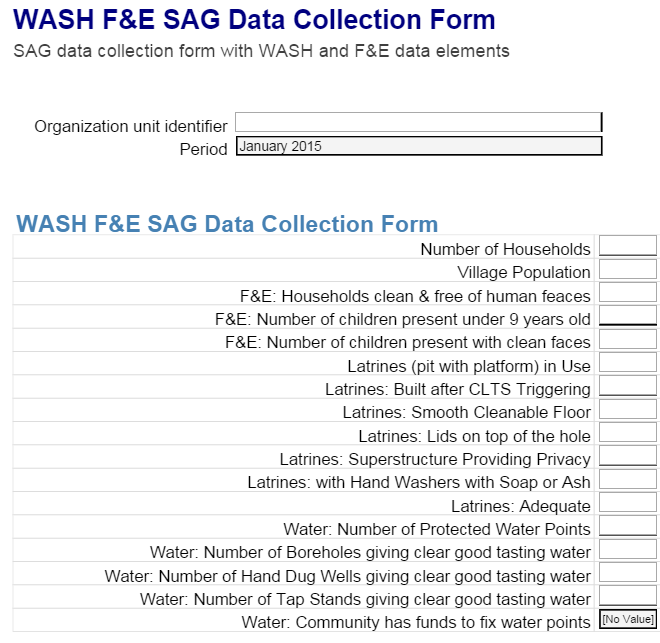
By keeping data collection sheets simple, by using clear data indicators, this meant that the data entered in to the system was also clear and only critical information was retained. As a result, analyzing and interpreting the data was much more straightforward. Another benefit of using very basic indicators was that any errors that slipped into the data could be spotted and rectified fairly simply.
Definição de funções
Akros has created three detailed end-user capacity assessments: the Stakeholder Role Rubric, the CLTS Surveillance Protocol and the CLTS Events Protocol. These documents serve the purpose of defining what each person does within a program so as to avoid ambiguity about responsibilities. Furthermore, the documents help to improve, monitor and assess the implementation of CLTS programs at the different roll out stages.
Avaliação da função do stakeholder
This document can enable a Community Health Worker to understand the full scope of his or her role. For example, they would know that they would be in charge of decision making in areas covering disease diagnosis, treatment administration, patient referrals, and commodity resupply checks. They would also know about the reporting requirements to follow such as the frequency and method to use.
Protocolo de Vigilância CLTS
The Surveillance Protocol is a document that is used to assign monitoring methodologies for each event. It is a detailed analysis of surveillance techniques against each critical event in CLTS deployment. Responsible parties, periodicity, the role of automated functions and manual (surveillance officer) functions are all identified.
Protocolo de Eventos CLTS
The CLTS Events Protocol is a document with a more detailed description of the critical events to be monitored. Responsible parties, periodicity, purpose and expected outcomes are identified, along with a brief narrative for context.
Promova um senso de responsabilidade
Promoting a sense of data ownership amongst participants has a great influence in helping to build up sustainable programs. It is therefore important to develop standard operating roles, by outlining the tasks and duties of every person interacting with the system.
Thus by making participants feel responsible for the data they’re in charge of and by promoting how their role is connected to the successful outcome of a CLTS project, this helps to maintain the flow of communication between all of the levels involved, whether it be at village, ward, constituency, district, province, national or organizational level.
Lições aprendidas
Compatibilidade com versões anteriores
Everything has to be backwards compatible to make upgrades into a smoother process. For example, in 2013, DHIS2 version 2.1.4 was unable to handle the growing volume of users as more and more districts started to use WASH. The system had to be upgraded, due to the number of legacy issues and bugs that were encountered. However, this was not a straightforward task and meant re-installing applications on all devices.
Usando clones de programas WASH experimentados e testados
Akros learned that it was beneficial to use clones of production instances as a means to ensure stable implementations of WASH. Upgrades were performed on the cloned instances and then upgrades were applied to the production instances. By proceeding in this anticipatory manner, costs were kept down and troubleshooting was reduced.
Use dados para conduzir a tomada de decisão
Using DHIS2-WASH is one thing; in fact it’s the easiest part. Getting people to use the data in order to drive decision making is the real challenge. To achieve this, Akros made it clear that all participants in a program should understand their role, responsibility and their intrinsic value within the program. Creating a sense of data ownership and a sense of accountability was therefore crucial. For example, by generating DHIS2 reports, district officers had the possibility to make comments about areas of improvement within their district. This information was then forwarded to a provincial coordinator who took action at his or her level.
Lastly, by ensuring that communication channels remained active and were maintained, Akros was able to see how their CLTS program took on more importance and credibility, which in turn generated positive results and recognition in many areas.