COVID-19 Case Surveillance & Contact Tracing Design
Demo: https://demos.dhis2.org/covid-19
Objectivo
O documento do Desenho do sistema de vigilância COVID-19 fornece uma visão geral do desenho conceptual usado para configurar um pacote de dados digitais COVID-19 no DHIS2. O pacote COVID-19 foi desenvolvido em resposta a uma necessidade expressa dos países de adaptar rapidamente uma solução para gerenciar dados do COVID-19. Este documento destina-se ao uso dos implementadores do DHIS2 em nível nacional e regional para poder oferecer suporte à implementação e localização do pacote. O pacote de metadados COVID-19 pode ser adaptado às necessidades locais e às diretrizes nacionais. Em particular, os fluxos de trabalho locais e as diretrizes nacionais devem ser considerados na localização e adoção dos programas incluídos neste pacote.
Fundo
This design has been updated to reflect new aggregate reporting requirements from the [WHO interim surveillance guidelines updated March 20, 2020][1]. The COVID-19 digital data package was developed in response to an expressed need from countries to rapidly adapt a solution for managing COVID-19 data. UiO has developed COVID-19 surveillance packages for three types of data models (tracker, event-based aggregate) to enable countries to select the model that is most appropriate for their context given the burden of disease and available resources. These models and their relative benefits/limitations are summarized below:
| Type of Surveillance Package | Case Surveillance (Tracker) | Surveillance (Event) | Surveillance (Aggregate) |
|---|---|---|---|
| Description | Enrols a case and tracks over time through laboratory confirmation & case outcome | Captures critical case details in line-listing format | Enables daily or weekly reporting of key aggregate data points |
| Pros | Highly granular data and multiple time dimensions for analysis, can support decentralized workflow, all events linked to the case | More granular than aggregate and can capture key time dimensions (i.e. report date vs onset of symptoms); reduced burden of data entry compared to tracker and little complexity | Low complexity, easy to implement, most manageable when cases numbers are high |
| Cons | Burden of data entry may be overwhelming when number of cases reach threshold; complexity of implementation | Does not support case-follow up or other decentralized workflows | Less granularity for detailed analysis (i.e. analysis only based on case reporting date, limited disaggregation) |
** Este documento cobre apenas o desenho do pacote de programas do rastreador de vigilância **; documentos de desenho de sistema separados estão disponíveis para pacotes DHIS2 e pacotes agregados.
A OMS está “instando todos os países a se prepararem para a chegada potencial do COVID-19, preparando sistemas de resposta a emergências; aumento da capacidade de detectar e cuidar de pacientes; garantir que os hospitais tenham espaço, suprimentos e pessoal necessário; e desenvolver intervenções médicas que salvam vidas. ”
Os objetivos da vigilância COVID-19 são:
- Monitorar tendências da doença onde ocorre transmissão humano a humano;
- Detectar rapidamente novos casos em países onde o vírus não está circulando;
- Fornecer informações epidemiológicas para realizar avaliações de risco aos níveis nacional, regional e global; e
- Fornecer informações epidemiológicas para orientar as medidas de preparação e resposta.
The system design builds upon existing case disease surveillance principles and information system requirements that have been developed collaboratively between the WHO and UiO since 2017. The COVID-19 surveillance package was developed with the intent to align to [WHO technical guidance on nCoV-19 surveillance and case definitions][2], updated March 20, 2020. Note that this design may not necessarily reflect the latest available interim global guidance developed by WHO as updates may be released rapidly. National guidelines and policies may vary and it is recommended to adapt this package to local context.
Resumo do Desenho do Sistema
The DHIS2 case surveillance tracker metadata was based on the [WHO COVID-19 case reporting template][3] and the mapping of data dictionaries can be accessed at: [DHIS2 CBS tracker metadata WHO line-list data dictionary][4].
In the development of this configuration package, an effort has been made to follow UiO’s [general design principles][5] and a common [naming convention][6].
The COVID-19 digital data package supports surveillance workflows and automated analysis for key components of routine and active surveillance. This package includes a Case Surveillance Tracker and Contact registration & follow-up tracker, which are installed together in the same metadata package. The tracker programs are optimized to be installed with other COVID-19 surveillance packages, including the Points of Entry Screening Tracker and aggregate daily surveillance dataset.
-
[Use Case 1: COVID-19 Case surveillance tracker][7]: enrols & tracks suspected cases; captures symptoms, demographics, risk factors & exposures; creates lab requests; links confirmed cases with contacts; and monitors patient outcomes. This package can be installed as a standalone COVID-19 package or can be integrated into a country’s existing integrated disease surveillance & response tracker. Metadata for the case surveillance tracker is aligned with the WHO [COVID-19 surveillance data dictionary][8]
n.b. The COVID-19 case tracker can be implemented either as a ‘standalone’ program for COVID-19 specific disease surveillance as described here; or, COVID-19 concepts can be integrated into an existing case surveillance tracker program if one already exists in-country. Please refer to installation and implementation guidance for more details.
-
[Use Case 2: Contact registration & follow-up][9]: strengthens active case detection through contact tracing activities, such as identification and follow-up of contacts of a suspected or confirmed COVID-19 case.
Digital data packages are optimized for Android data collection with the DHIS2 Capture App, free to download on the [Google Play store][10].
Use Case 1: COVID-19 Case surveillance tracker
The COVID-19 case surveillance tracker can be adapted and used by countries to supplement existing national disease surveillance programs. The basic case surveillance program is designed to:
- Enroll suspected* COVID-19 cases (generally appearing at a health facility, but may be enrolled at other places)
- Capture informações importantes sobre o caso suspeito, incluindo dados demográficos e exposições, como sintomas, entre em contacto com um caso previamente confirmado e histórico de viagens
- Gera solicitações de laboratório
- Registrar diagnóstico de laboratório
- Record contacts of a confirmed** or probable*** case for follow-up
- Registrar o resultado do caso
- Facilitar a notificação de casos e a notificação de casos nacionais / regionais / globais
- Gere painéis e ferramentas de análise para monitorar tendências de doenças e planejar estrategias de resposta
The design of the case tracker program assumes that [WHO case definitions][1] are followed in the use case; its use can be adapted to local case definitions as needed. The WHO case definitions were updated on March 20, 2020 and noted below.
* Suspected case: A) a patient with acute respiratory illness (fever and at least one sign/symptom of respiratory disease (e.g., cough, shortness of breath), AND with no other aetiology that fully explains the clinical presentation AND a history of travel to or residence in a country/area or territory reporting local transmission of COVID-19 disease during the 14 days prior to symptom onset; OR, B) A patient with any acute respiratory illness AND having been in contact with a confirmed or probable COVID-19 case (see definition of contact) in the last 14 days prior to onset of symptoms; OR, C) A patient with severe acute respiratory infection (fever and at least one sign/symptom of respiratory disease (e.g., cough, shortness breath) AND requiring hospitalization AND with no other aetiology that fully explains the clinical presentation.
** Probable case: A) a suspect case for whom testing for COVID-19 is inconclusive (inconclusive being the result of the test reported by the laboratory) OR, B) a suspect case for whom testing could not be performed for any reason.
*** Confirmed case: A person with laboratory confirmation of COVID-19 infection, irrespective of clinical signs and symptoms.
Intended Users
- Os utilizadores de unidades de saúde: capturam e registram detalhes sobre um caso suspeito, incluindo sintomas e exposições clínicas; acompanhar os resultados do laboratório; resultado do caso de registo
- Os utilizadores de laboratório: receba solicitações de laboratório e registe resultados de laboratório para um caso suspeito em particular
- Autoridades nacionais e locais de saúde: monitorar e analisar dados de vigilância de doenças por meio de painéis e ferramentas de análise para conduzir avaliações de riscos e planejar medidas de resposta; gerar relatórios para relatórios regionais e globais
Workflow: COVID-19 Case Surveillance Tracker
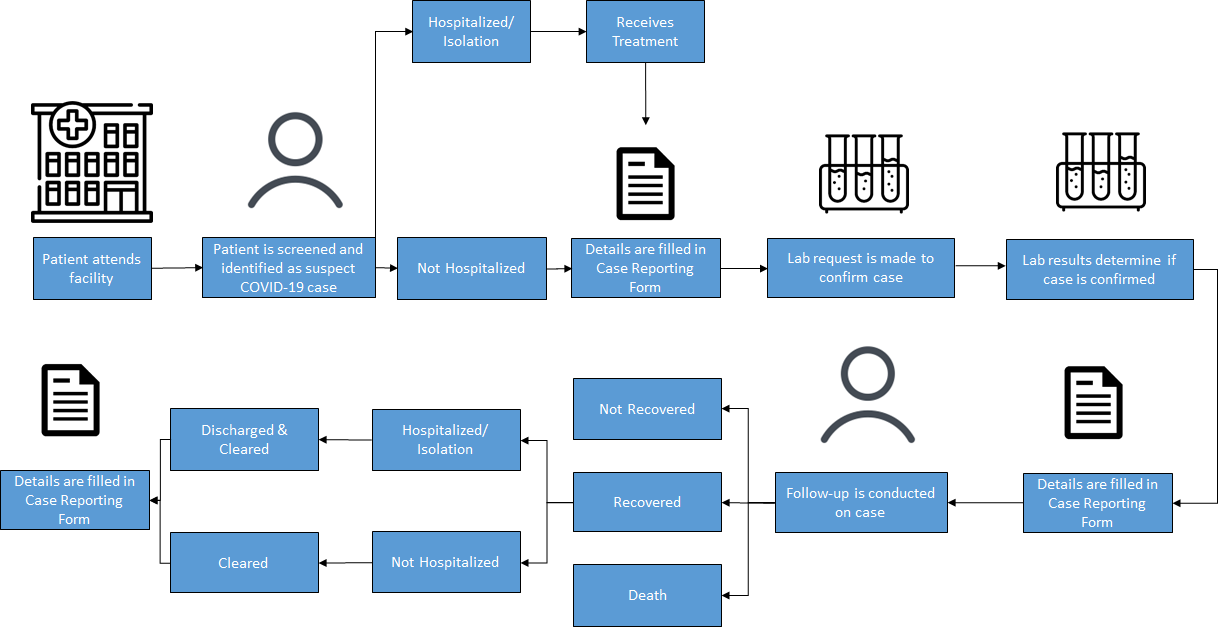
Estrutura: COVID-19 Programa de rastreio de Vigilância de casos
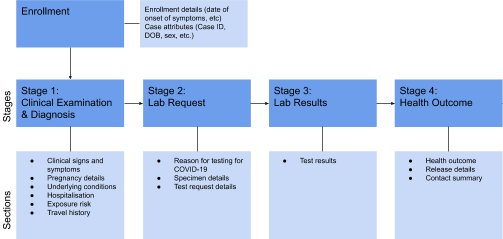
Descrição do Programa:COVID-19 Teste de caso, Diagnóstico e resultado
| Stage | Descrição |
|---|---|
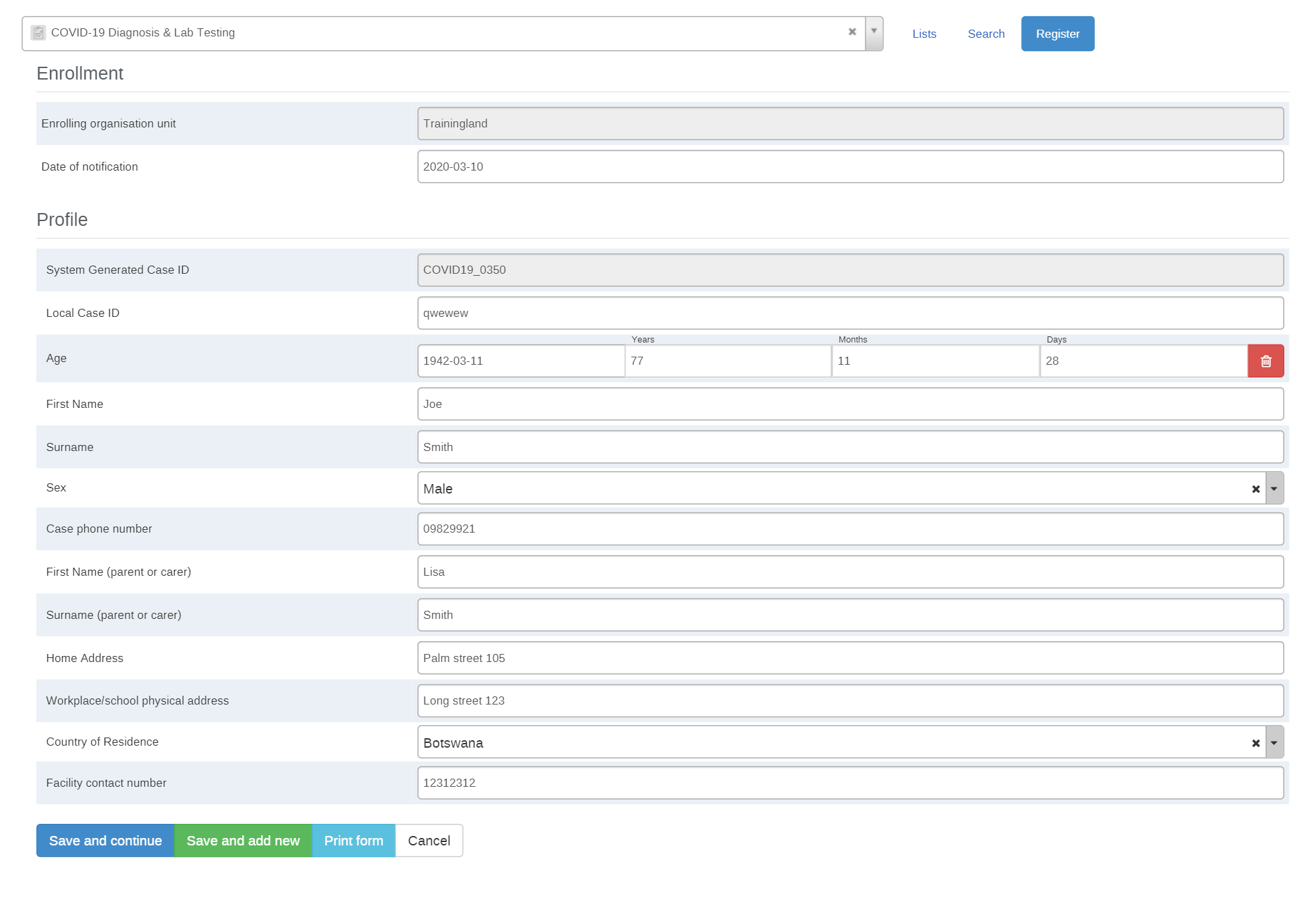
| Enrollment details & Attributes | The Tracked Entity is the case, which is represented by a Tracked Entity Type of ‘person.’ The Enrollment date is the date of registration of the case. The Related programs is COVID-19 Contact registration & follow-up. The attributes include the following basic personal information and unique case identifiers: System Generated Case ID, Local Case ID, Age, First Name, Surname, Sex, Case phone number, First Name (parent or care), Surname (parent or carer), Home Address, Workplace/school physical address, Country of Residence, Facility contact number |
| Stage 1: Clinical Examination and Exposures | This stage records a suspected case’s clinical symptoms and exposures including: Symptoms, Pregnancy and underlying conditions, Hospitalisation and Isolation, Exposures in 14 days prior to symptoms, Travel history, Contact with confirmed case. After examination, you can record if the case has been hospitalised or isolated, and information surrounding this. |
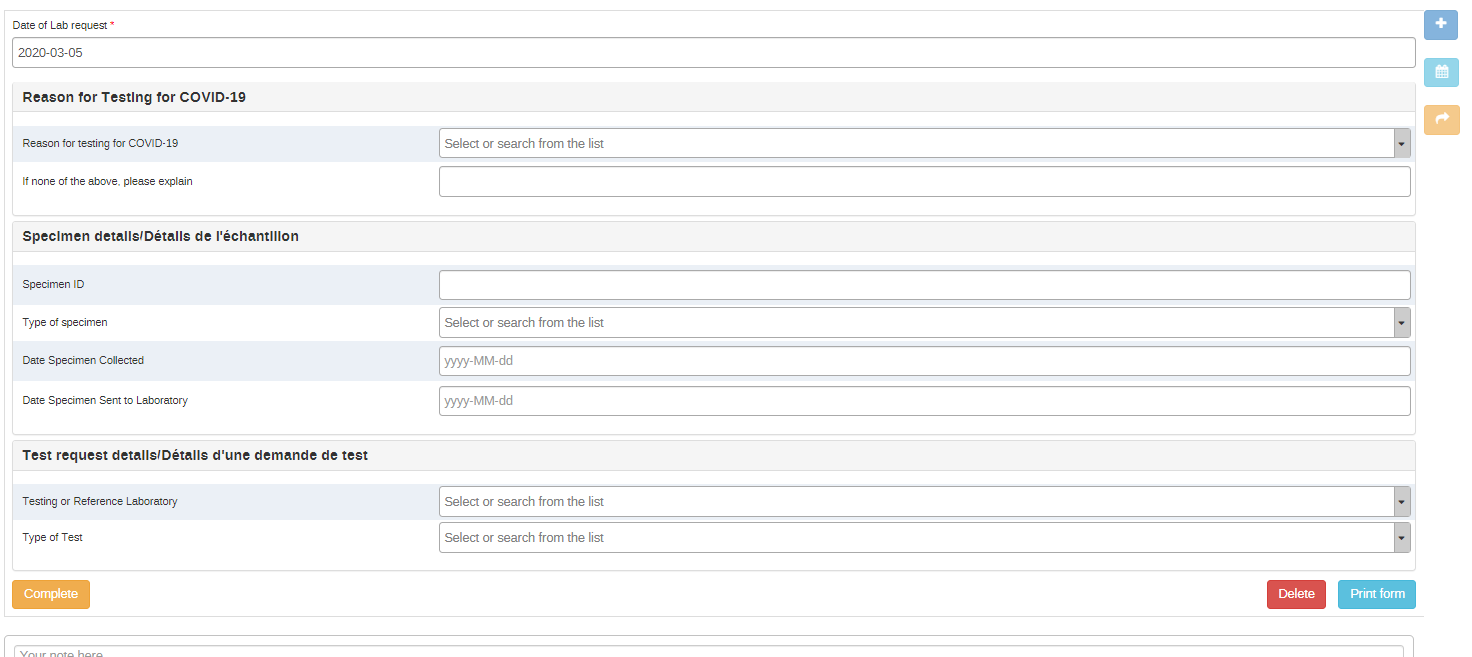
| Stage 2: Lab Request [repeatable] | The lab request records the reason for testing and other information that a lab needs to process a sample and test it for COVID19. The information provided here can help lab personnel prioritize lab tests when resources are limited. The person entering this data could be the same person who registered the suspected case and recorded the patient’s clinical exam and exposures; or may be other personnel charged with making lab requests. |
| Stage 3: Lab Results [repeatable] | The Lab Results stage records the type and results from laboratory testing. It can be done directly at the lab or as secondary data entry. This stage is repeatable as samples for a given case may be tested multiple times (i.e. in the case of an inconclusive laboratory results, a new lab test can be conducted and results recorded). |
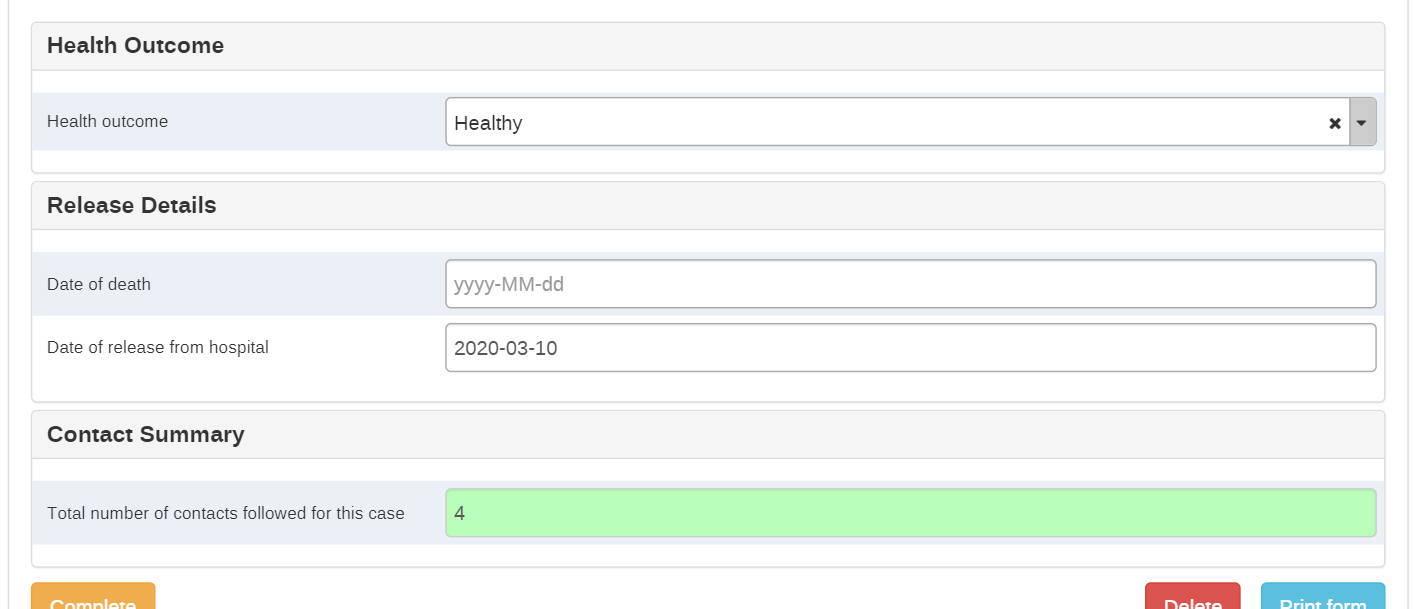
| Stage 4: Health Outcome | The health outcome records the final outcome of the case: (recovered, not recovered, dead or unknown) including date of discharge or death as applicable. |
Enrollment Stage
Program Stage 1 - Clinical Examination & Diagnosis
Secção 1 - Sinais e sintomas clínicos
Selecting “yes” to the Data Element ‘Any signs or symptoms?’ reveals the rest of the options.

Secção 2 - Detalhes da gravidez
Esta secção está oculta, a menos que o sexo seja selecionado como "Feminino".

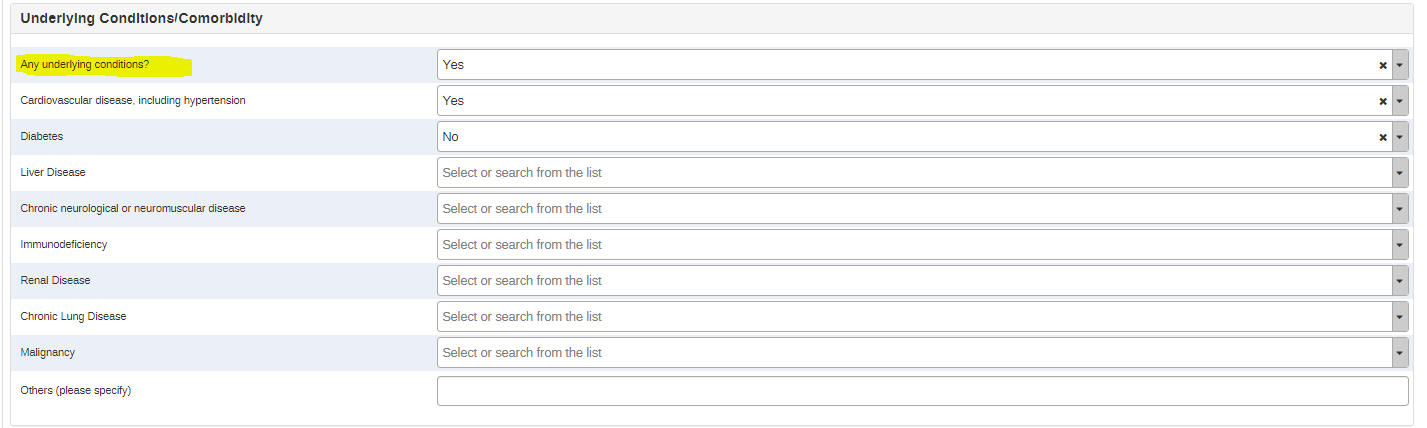
Secção 3 - Condições subjacentes / Comorbidade
The details of this section are hidden unless “Any underlying conditions” is marked as “Yes”.
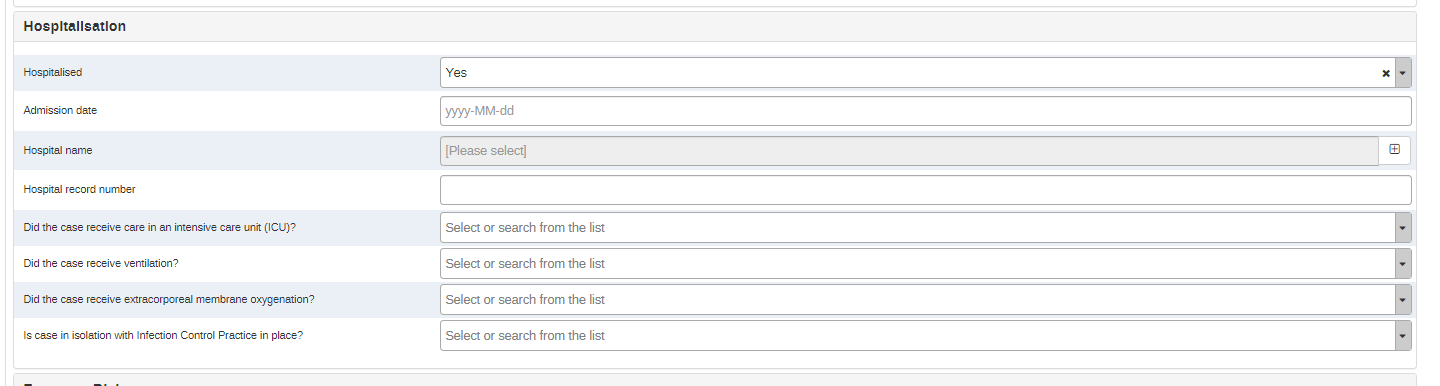
Secção 4 - Hospitalização
The details of this section is hidden unless “Hospitalised” is marked as “Yes”.
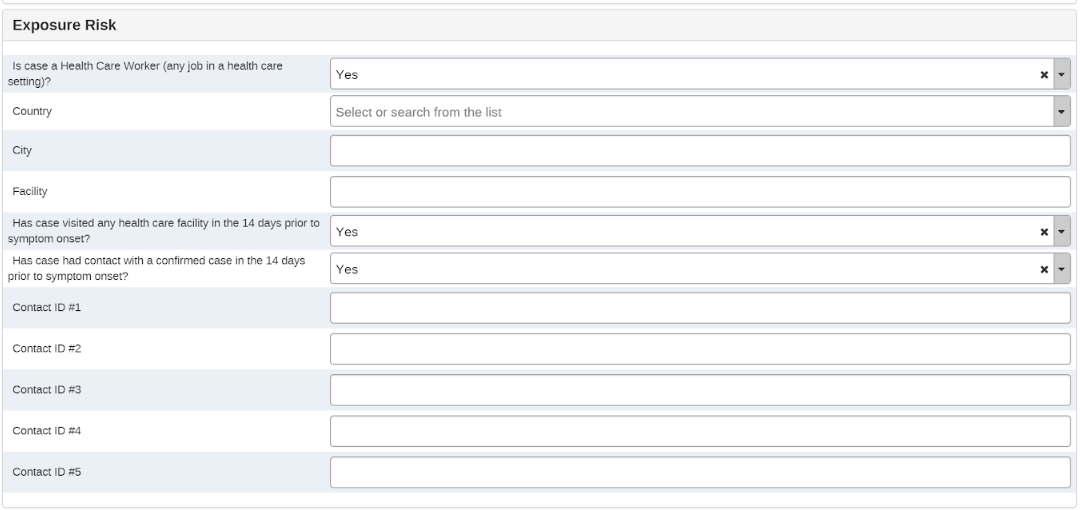
Section 5 - Exposure Risk
This section is used to record exposures
- The fields country, city and facility are hidden by program rules if the case is not a health care worker;
- The fields for contact IDs are hidden by program rules if the case has not had contact with a confirmed case in 14 days.
A suspected case’s exposure to a previously confirmed case is distinct from prospective contact tracing in Program Stage 5.
Secção 6 - Histórico de viagens

Programa Etapa 2: Solicitação de Laboratório
Etapa 3: Resultados do laboratório

Etapa 4: Resultados da Saúde
Regras do programa: COVID19 Rastreador de vigilância baseada no caso
The following program rules have been configured. If a country has an existing case surveillance program and wishes to incorporate elements of the COVID-19 case tracker into their existing program, special attention must be paid to the configuration of program rules.
| Program Rule Name | Program Rule Description |
|---|---|
| Assign Enrollment Date | This assigns the enrollment date if there is no onset date available to the variable calculated onset date (for indicators). This variable is used as a custom parameter in some of the program indicators. |
| Assign Onset Date | This assigns the onset date to the variable calculated onset date (for indicators). This variable is used as a custom parameter in some of the program indicators. |
| Calculate and assign patient age in years | Calculate and assign patient age in years based on DOB |
| Display patient age in years + days | Display patient age in years + days |
| Hide Date of Death | Hide the Date of Death unless Death is the health outcome |
| Hide Date of Discharge | Hide Date of Discharge if no outcome or if the outcome is death |
| Hide Measured Temperature field | Hide Measured Temperature field until Fever is selected |
| Hide confirmed case ID's if no contact with other confirmed cases | Hides any contact ID's if the case has not been in any contact with other confirmed cases |
| Hide health care worker details if not a health worker | Hide health care worker details if not a health worker |
| Hide health outcome explanation if health outcome is not other | Hide health outcome explanation if health outcome is not other |
| Hide hospitalisation details if hospitalisation is no or unknown | Hide hospitalisation details if hospitalisation is no or unknown |
| Hide isolation date if case is not in isolation | Hide isolation date if case is not in isolation |
| Hide pregnancy details for a female if not pregnant | Hide pregnancy details for a female if not pregnant |
| Hide pregnancy details section if sex is male | Hide pregnancy details section if sex is male |
| Hide reason for testing explanation if an option is selected | Hide reason for testing explanation if an option is selected |
| Hide travel history details if no travel 14 days prior to symptom onset | Hide travel history details if no travel 14 days prior to symptom onset |
| Hide underlying conditions if case does not have any | Hide underlying conditions if case does not have any |
| Show warning if the event date is after the enrollment date | Show warning on completion of an event if the event date is before the enrollment date |
You can read more about program rules here: [https://docs.dhis2.org/master/en/user/html/configure_program_rule.html][11]
Indicadores de programa
A partir dos dados capturados no programa de vigilância de casos COVID-19, podemos calcular pelo menos os seguintes indicadores, incluindo os recomendados pela OMS para relatórios agregados diários e semanais, e apresentá-los em um painel:
| Indicator name | Descrição |
|---|---|
| COVID-19 - Cases treated with mechanical ventilation or ECMO or admitted in intensive care unit (ICU) | Cases treated with mechanical ventilation or ECMO or admitted in intensive care unit (ICU) |
| COVID-19 Contacts | Counts the number of relationships (‘has been in contact with’) created that are linked to the case TEI |
| COVID-19 - Deaths (all suspected cases) | COVID-19 related deaths (deaths recorded among all suspected cases) |
| COVID-19 - Deaths (confirmed cases) | COVID-19 related deaths (deaths recorded among confirmed cases) |
| COVID-19 - Deaths (probable cases) | COVID-19 related deaths (deaths recorded among all probable cases) |
| COVID-19 - Confirmed Hospitalised Cases | Number of confirmed cases that were admitted into hospital |
| COVID-19 - Imported Cases | Cases where likely source of infection is recorded as another country or imported from another country. |
| COVID-19 - Laboratory confirmed cases | Suspected cases that were confirmed through laboratory testing (multiple lab tests may be conducted; this indicator assumes that the last test result is "Positive"); displayed by report date |
| COVID-19 - Laboratory confirmed cases - by onset of symptoms | Suspected cases that were confirmed through laboratory testing (multiple lab tests may be conducted; this indicator assumes that the last test result is "Positive"); displayed by date of onset of symptoms |
| COVID-19 - Laboratory tested cases | Number of suspected cases that received a laboratory test (includes inconclusive lab testing results) |
| COVID-19 - Local transmission cases | Number of suspected cases where transmission is local (no travel in last 14 days |
| COVID-19 - Probable cases | Suspected cases with inconclusive laboratory results or not tested for any reason, by reported date |
| COVID-19 - Probable cases - by onset of symptoms | Suspected cases with inconclusive laboratory results or not tested for any reason, by date of onset of symptoms |
| COVID-19 - Recovered confirmed cases | Number of laboratory confirmed cases with outcome recovered |
| COVID-19 - Suspected cases | Total number of cases suspected with COVID-19, by report date |
| COVID-19 - Suspected cases - by onset of symptoms | Total number of cases suspected with COVID-19, by date of onset of symptoms |
| COVID-19 - Suspected cases without a positive test result | Total number of suspected cases without a positive lab result |
| COVID-19 Total number of laboratory tests conducted | Total number of lab tests conducted (count of tests, not cases) |
| COVID-19 Total number of positive tests | Total number of lab tests returned with positive results (count of tests, not cases |
| COVID-19 Deaths by sex and age group | Male: 0-4, 5-14, 15-24, 25-34, 35-44, 45-54, 55-64, 65-74, 75-84, 85+ | **Female*: 0-4, 5-14, 15-24, 25-34, 35-44, 45-54, 55-64, 65-74, 75-84, 85+* |
| COVID-19 Confirmed cases by sex and age group | Male: 0-4, 5-14, 15-24, 25-34, 35-44, 45-54, 55-64, 65-74, 75-84, 85+ | **Female*: 0-4, 5-14, 15-24, 25-34, 35-44, 45-54, 55-64, 65-74, 75-84, 85+* |
| COVID-19 Suspected cases by sex and age group | Male: 0-4, 5-14, 15-24, 25-34, 35-44, 45-54, 55-64, 65-74, 75-84, 85+ | **Female*: 0-4, 5-14, 15-24, 25-34, 35-44, 45-54, 55-64, 65-74, 75-84, 85+* |
Caso de uso 2: COVID-19 Registo de registo e acompanhamento
This program can be used in addition to the case surveillance tracker to facilitate the registration and follow-up of contacts of a confirmed case. In this scenario, it is assumed that if any contacts of a confirmed case meet criteria for suspected case and are referred for testing, the case will be enrolled into the COVID-19 Case Surveillance tracker program.
O programa de registro e acompanhamento de contatos registra cada contato de um caso (como descrito no Caso de Uso de Vigilância de Casos COVID-19) como uma nova Instância de Entidade Rastreada (pessoa) e os vincula ao caso no Programa de Vigilância de Casos COVID-19 via um 'relacionamento'. Ele possui um estágio simples e repetitivo de acompanhamento, onde os sintomas e qualquer acompanhamento realizado podem ser registrados.
Fluxo de trabalho: registro e acompanhamento de contatos
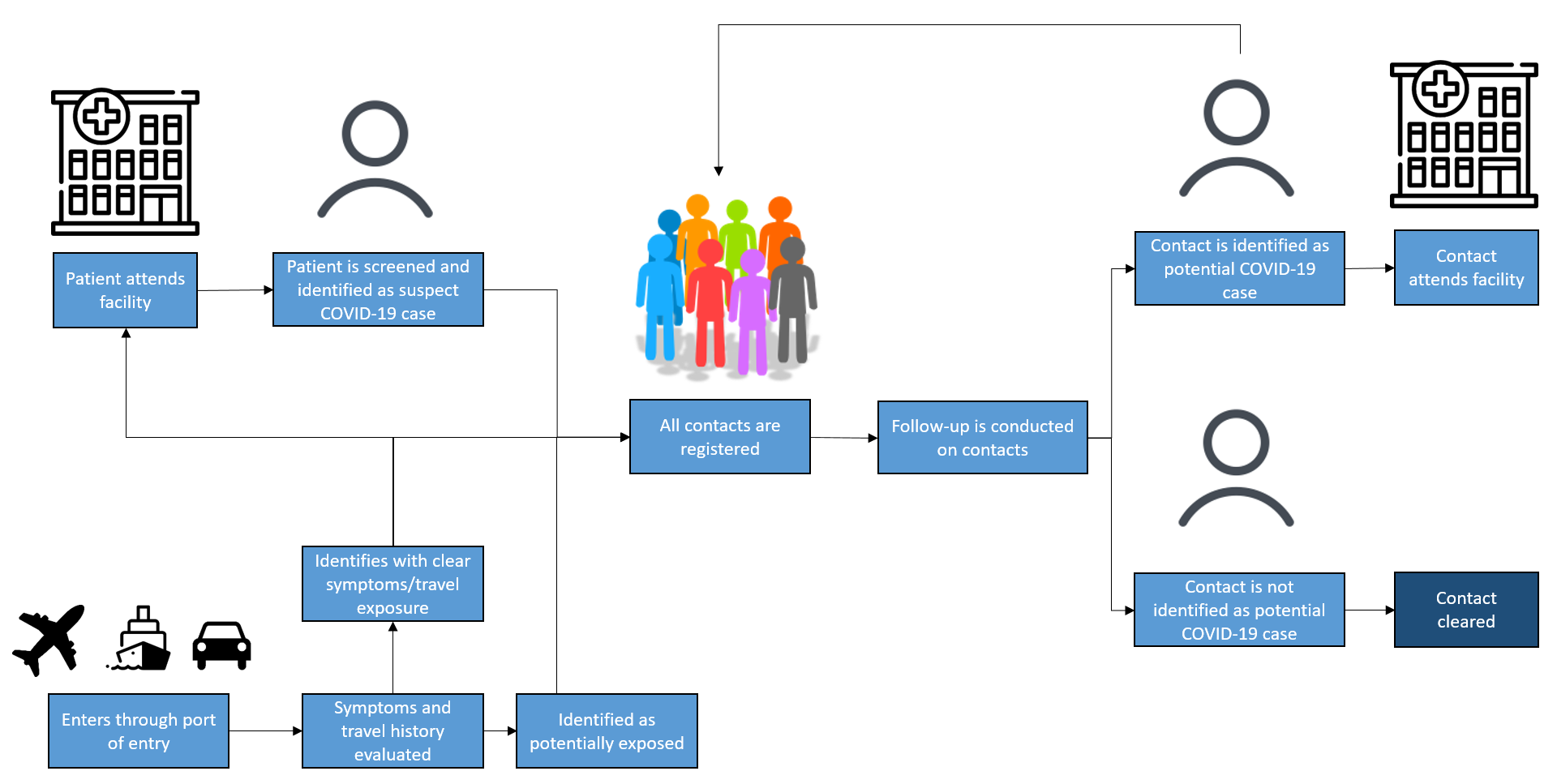
Descrição do Programa: Registro e acompanhamento de contactos
| Stage | Descrição |
|---|---|
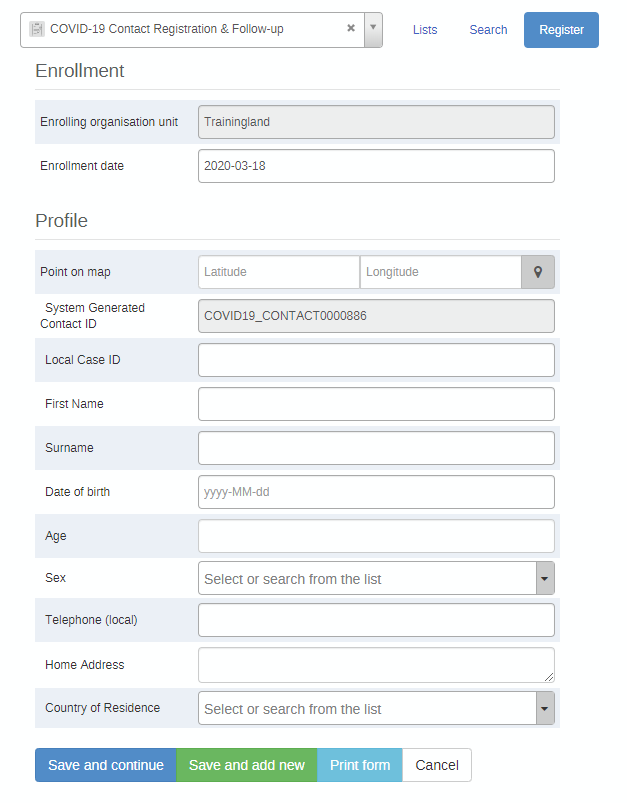
| Enrollment details & Attributes | The Tracked Entity is represented by a Tracked Entity Type of ‘person.’ The Related program is COVID-19 Case based surveillance. The attributes include the following basic personal information and unique case identifiers: System Generated Case ID, Local Case ID, First Name, Surname, Date of birth, Age, Sex, Phone number (local), Home Address, Country of Residence |
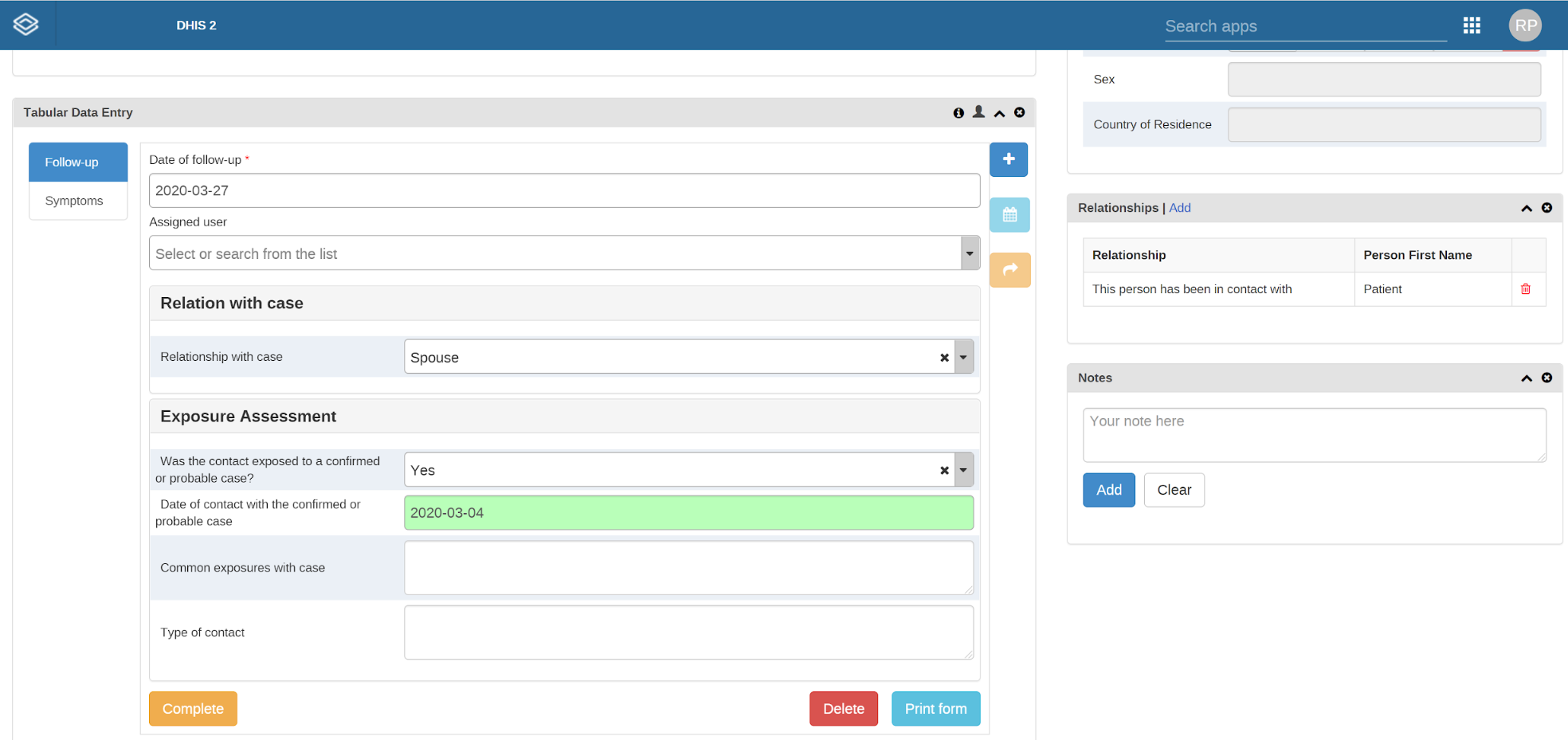
| Stage 1: Follow-Up [non-repeatable] | This stage is meant to record information related to contact tracing follow up, given that a contact has already been identified. It is divided into two sections: 1. Relation with case, 2. Exposure Assessment |
| Stage 2: Symptoms[repeatable] | This stage is intended to record symptoms of the case. Follow-up to check on the symptoms of a contact can be repeated until the follow-up period is complete (for example, after 14 days or according to national guidelines). When follow-up period is complete, the enrollment can be ‘completed.’ 1. Symptoms |
Os contactos são adicionados ao caso de índice usando o menu de relacionamentos no programa de vigilância de casos:
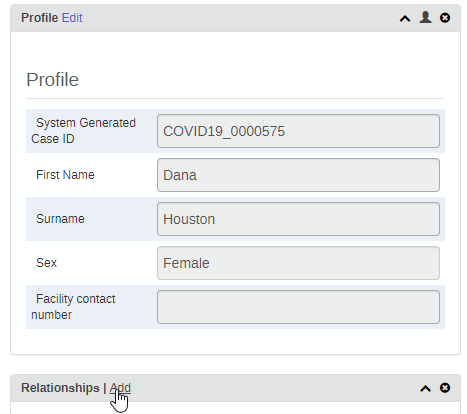
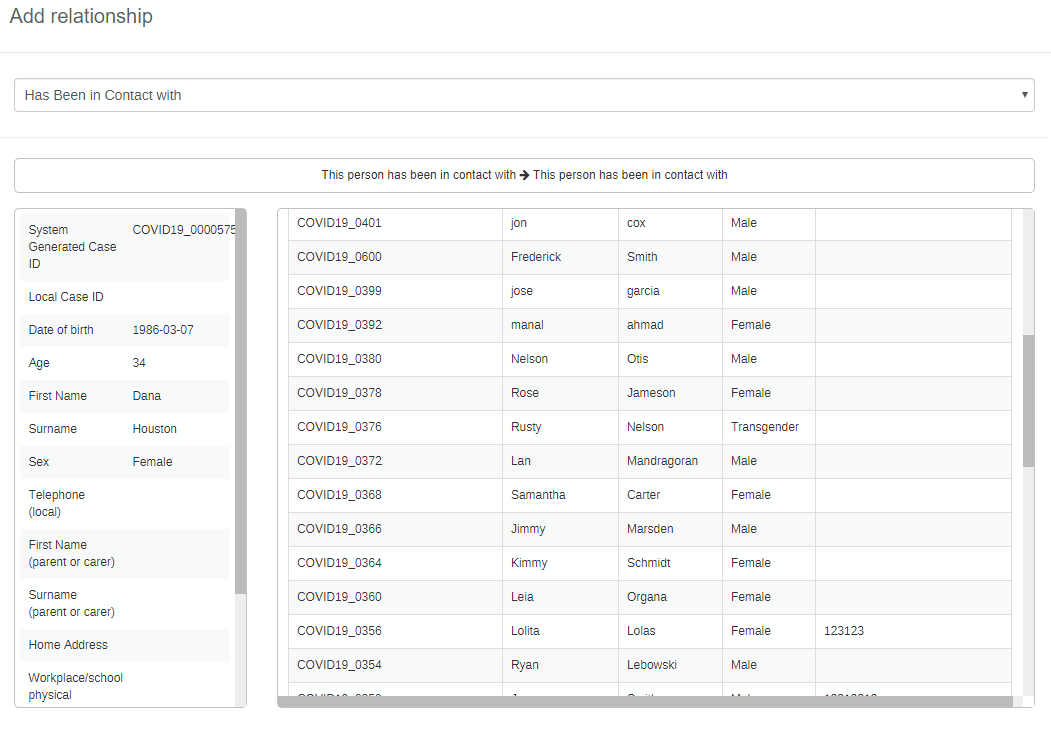
Once you select “Add” from the relationships box, you are able to select the relationship and program and either select an existing person or enroll a new contact using the enrollment stage that appears. This will enroll the contact into the contact registration and follow-up program.
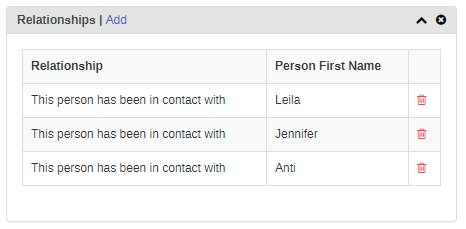
Contacts that are added will then be listed on the case’s tracker dashboard in the relationship widget
Você também pode inscrevê-los separadamente no programa. Após a inscrição, você poderá encontrá-los para o acompanhamento, conforme necessário.
Inscrição
Programa Etapa 1: Acompanhamento
Programa Etapa 2: Sintomas

Indicadores de Programa: Registo de Contato
| Program Indicator Name | Descrição |
|---|---|
| COVID-19 travelers screened | Total number of travelers screened and enrolled in screening program from POE |
| COVID-19 travelers cleared at POE | Number of travelers cleared after POE screening (no follow-up required) |
| COVID-19 travelers with symptoms at POE | Number of travelers presenting with symptoms during POE screening |
| COVID-19 travelers cleared after 14 days monitoring | Number of travelers that are cleared after 14 day follow up (no onset of symptoms during 14 day period) |
| COVID-19 travelers referred to health facility | Number of travelers that were referred to a health facility at any time during 14 day followup |
| COVID-19 travelers enrolled for 14 day follow-up | Number of travelers that did not present with symptoms at POE screening and were not cleared at POE screening |
| COVID-19 currently under follow-up | Number of travelers that have not been cleared or referred to a health facility |
| COVID-19 travelers developed symptoms during follow-up | Number of travelers that developed symptoms during follow-up (exclude travelers presenting with symptoms during POE screening) |
Referências
- Orientação técnica da OMS sobre a vigilância COVID-19 e definições de caso (última atualização em 20 de março de 2020)https://www.who.int/emergencies/diseases/novel-coronavirus-2019/technical-guidance/surveillance-and-case-definitions
- WHO Data Dictionary for COVID-19 Case Reporting Form https://www.who.int/docs/default-source/coronaviruse/2020-02-27-data-dictionary-en.xlsx
- Testes laboratoriais da OMS para o novo coronavírus de 2019 (2019-nCoV) em suspeitos de casos humanos (última atualização em 2 de março de 2020) https://www.who.int/publications-detail/laboratory-testing-for-2019-novel-coronavirus-in-suspected-human-cases-20200117
- Considerações da OMS na investigação de casos e agrupamentos de COVID-19 (última atualização em 13 de março de 2020) https://www.who.int/internal-publications-detail/considerations-in-the-investigation-of-cases-and-clusters-of-covid-19
- Relatórios de situação do Coronavirus da OMS https://www.who.int/emergencies/diseases/novel-coronavirus-2019/situation-reports
[1]: https://apps.who.int/iris/bitstream/handle/10665/331506/WHO-2019-nCoV-SurveillanceGuidance-2020.6-eng.pdf [2]: https://www.who.int/emergencies/diseases/novel-coronavirus-2019/technical-guidance/surveillance-and-case-definitions [3]: https://www.who.int/docs/default-source/coronaviruse/2020-02-27-data-dictionary-en.xlsx [4]: https://drive.google.com/open?id=1vigXHkP7L2hJ2lrZpdf9u4csQtppMH16 [5]: https://docs.dhis2.org/en/topics/metadata/dhis2-who-digital-health-data-toolkit/general-design-principles-for-who-metadata-packages.html [6]: https://docs.dhis2.org/en/topics/metadata/dhis2-who-digital-health-data-toolkit/naming-conventions.html [7]: #use-case-1-covid-19-case-surveillance-tracker [8]: https://www.who.int/docs/default-source/coronaviruse/data-dictionary-covid-crf-v6.xlsx?sfvrsn=a7d4ef98_2 [9]: #use-case-2-covid-19-Contact-registration-follow-up [10]: https://play.google.com/store/apps/details?id=com.dhis2&hl=en [11]: https://docs.dhis2.org/en/use/user-guides/dhis-core-version-master/configuring-the-system/programs.html#configure_program_rule