Tableau de bord d'analyse des goulets d'étranglement et Serveur démo
Introduction à l'application BNA
Bottleneck analysis (BNA) is a structured analysis of the determinants of coverage for a wide range of interventions delivered through the health sector, useful to supporting targeted operational planning. It is a systematic, outcome-based approach to equitable health programming and real-time monitoring that strengthens the health system, complementing and building on what exists.
The BNA App is developed and maintained by the HISP Community (UiO, HISP-Tanzania and HISP Uganda) in collaboration with UNICEF. The BNA app is available here for download. It is currently compatible with DHIS2 2.28 and above.

Justification de l'application BNA
Health managers have competing demands resulting in limited time, resources and training to conduct data analysis. Collecting data from multiple sources and preparing it for analysis themselves can be a barrier to effectively using data for planning. While the growing trend of building dashboards into DHIS2 is encouraging, too often the information displayed in dashboards is a collection of related (or sometimes unrelated) indicators rather than a well thought out process (or framework) of how a workflow or intervention actually works. The bottleneck analysis app helps address these issues by automating data gathering and presentation within DHIS2 and displaying it in a manner that facilitates systematic analysis for programming.
Effective and timely use of DHIS2 data by stakeholders at all levels of health system is critical for health service delivery. DHIS2 dashboards have the potential to enhance the use of data for decision making and planning by displaying information for managers in an accessible and actionable manner. This visualization is made possible by using the bottleneck analysis model integrated with the causality and tracking actions/solutions to effect interventions.
Avantages de l'application BNA
The bottleneck analysis and planning approach contribute to existing national and sub-national planning and monitoring cycles by offering a strategic, rapid and systematic approach to analyzing key health systems barriers to reaching intervention coverage targets.
This approach can help save time and increase the efficiency of resources available by identifying where the greatest pockets of unmet needs or poor service outcomes exist and, in those places, identifying key bottlenecks, prioritizing what should be addressed immediately, what should be deferred (prioritization of most effective actions) and ensuring that resources are programmed to tackle priority bottlenecks with evidence-informed solutions.
À propos du serveur démo et des méta-données de l'application BNA
The BNA demo server is setup to support both development, testing, training and ensuring quality of features and functions of the demo server. Additionally, the demo server is also setup to host both demo data and metadata across various interventions to give chance to users of the system to explore and learn system features and functions. The current demo server can be accessed on : https://hisp.apps.dhis2.org/training/
The server is hosted in the cloud and can be accessed on the internet via a browser from anywhere as long as there is availability of internet.
Accès à l'application BNA
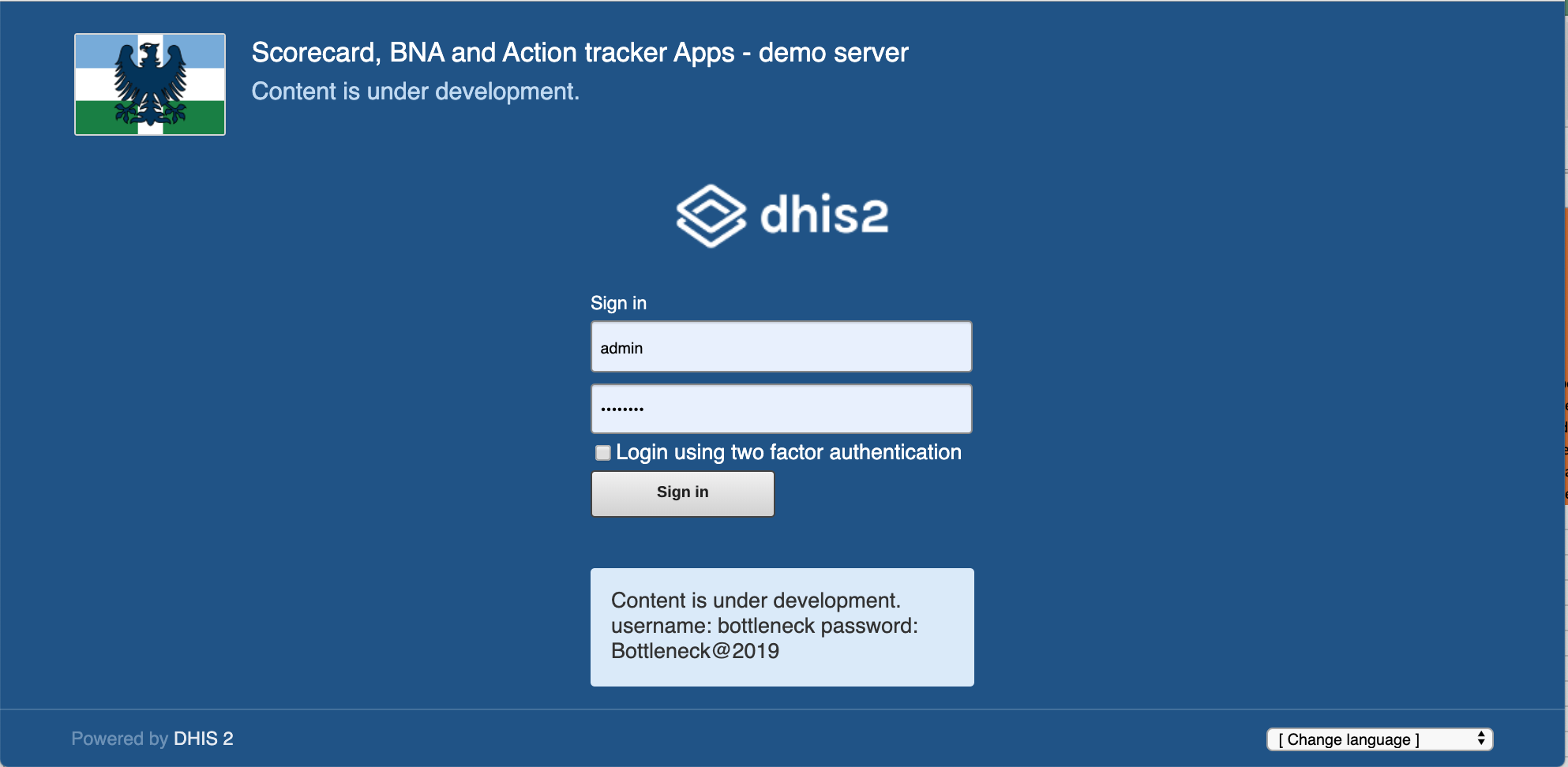
This user guide is documented using the linked BNA App which is available on the DHIS2 demo server. The BNA app is set up in the DHIS2 Demo server and with linkages to the Scorecard, Root Cause Analysis and Action Tracker Apps. The current demo server can be accessed on: https://hisp.apps.dhis2.org/training/ with the username and password provided on the login page..
Gestion des indicateurs
The BNA app borrows its meta-data from the general DHIS2 data source and uses this to create a data store for ease of analysis. Bottleneck analysis metadata such as indicators and indicator groups are managed using the DHIS2 Indicator maintenance App.
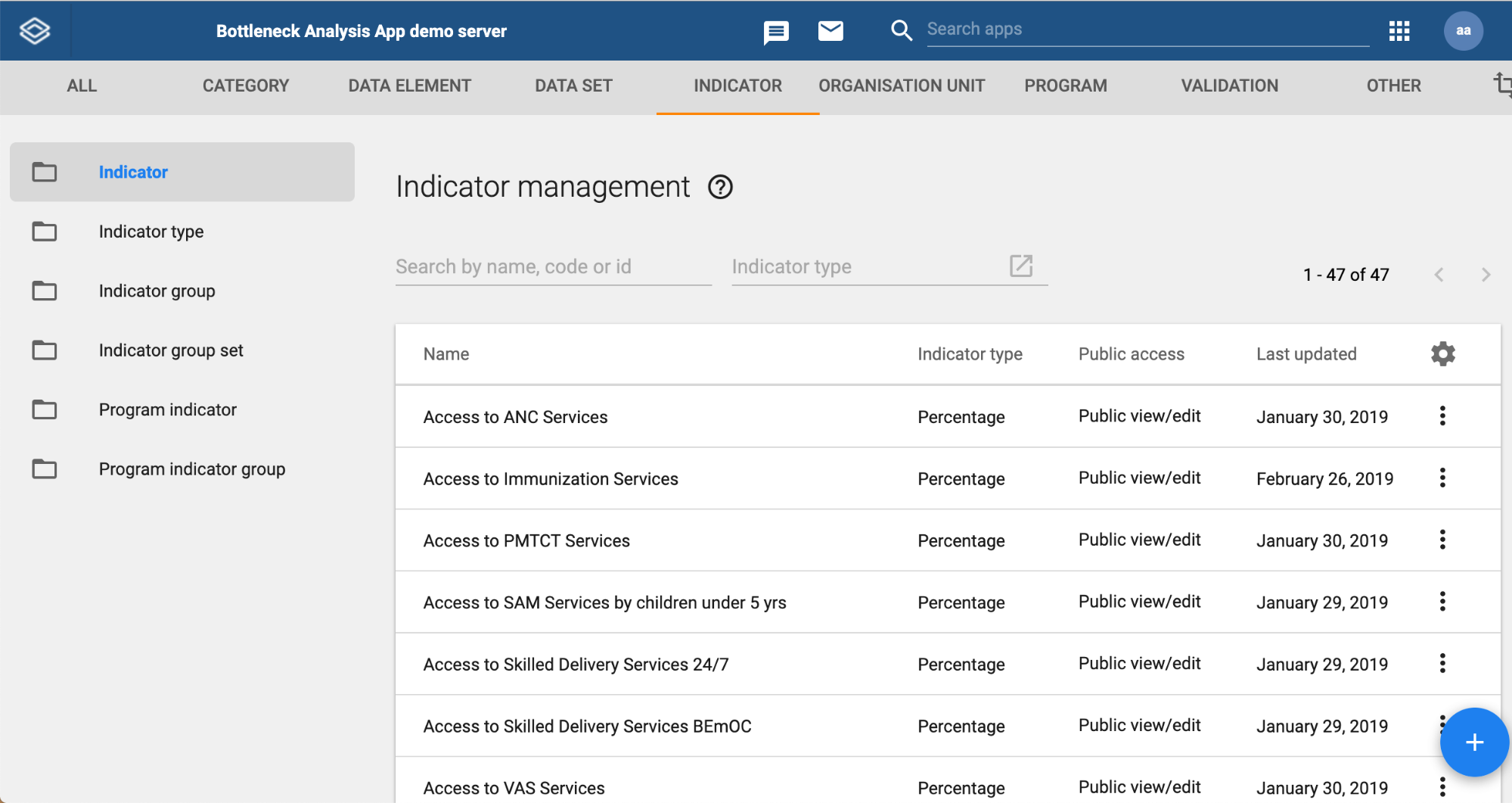
Complex indicators that require additional calculations are maintained using the function maintenance app. These include but are not limited to indicators on stock data, Human resources.
Application de maintenance des fonctions
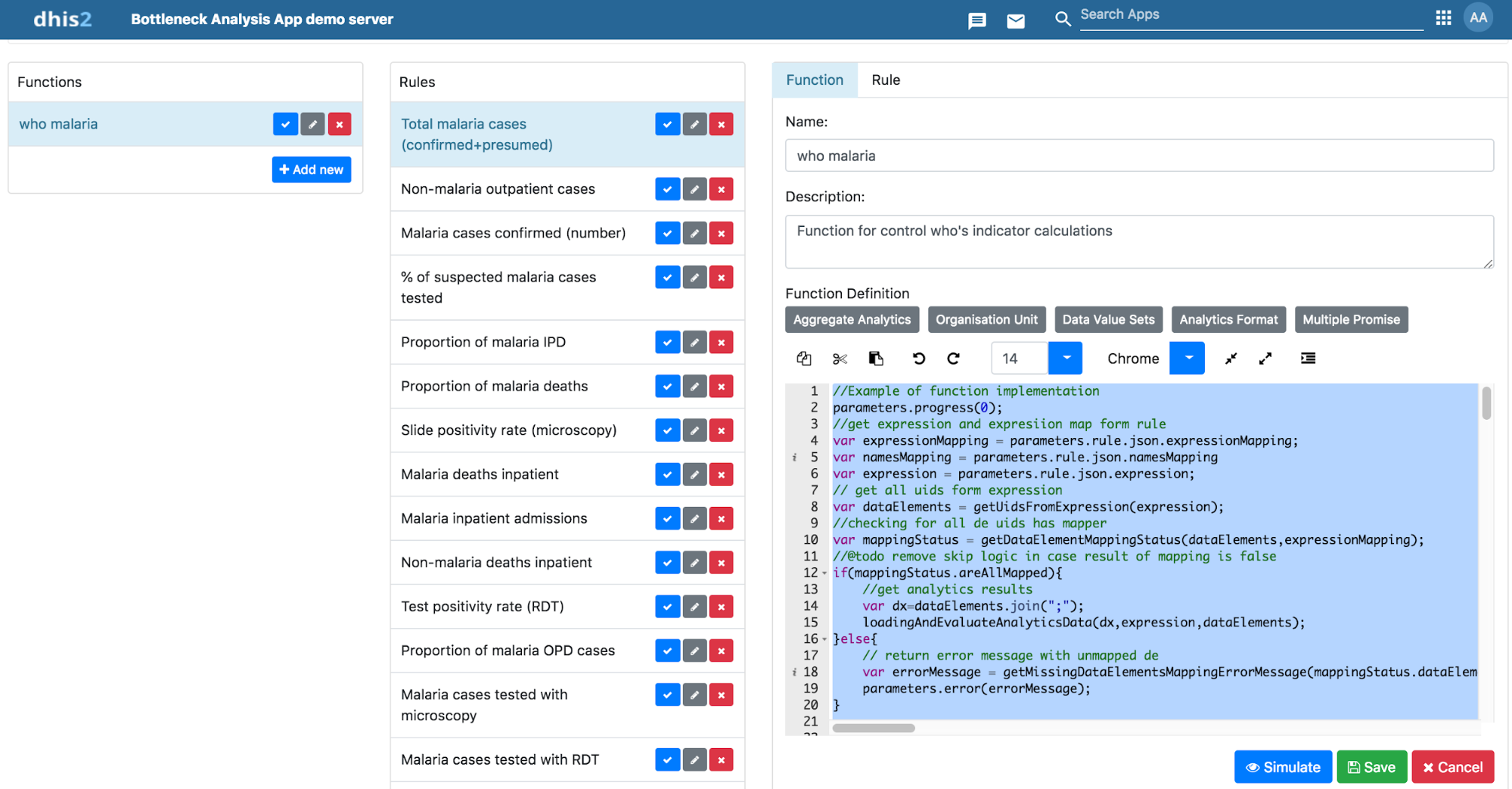
The BNA App is also integrated with function maintenance App, used to create custom indicators. Custom Indicators are indicators whose definition and calculation cannot easily be created using the Indicator maintenance app in the DHIS2. The app can be easily used by developers to create custom codes to retrieve and use indicators with complex calculations. To use the app, find it here