DHIS2 tracker e-Registry in Palestine
Developed from WHO’s guidelines for Reproductive, Maternal, Newborn and Child Health (RMNCH), the DHIS2 Tracker e-Registry collects, analyzes and tracks case-based data for maternal and child health. The module is currently being rolled out in three of the 10 regions in the West Bank. The remaining regions will be covered over the upcoming months.

How did the Tracker come about? Primary health care is at a particularly low level for expectant women due to the volatile context within Palestine. The DHIS2 Tracker e-Registry was introduced in an attempt to improve the delivery of quality healthcare. The e-Registry captures essential health data through simple processes and a series of outcome indicators covering domains of quality of care. It also serves the dual purpose of patient management and public health monitoring. The project is being led by the Norwegian Institute of Public Health, with the involvement of the Palestinian National Institute of Public Health and the Ministry of Health in Palestine.

What was not in place before that is available now with Tracker? Tracker has provided national guidelines and support for clinicians when following individual cases. For example, if a clinician enters a lab result for a pregnant woman, let’s say the hemoglobin value, which indicates anemia, the clinician is alerted to the patient’s degree of anemia and will be prompted to take action accordingly. This information is powered by a powerful rule engine, and is based on WHO guidance about what actions to take in certain health situations.

What exactly is the DHIS2 Tracker e-Registry? The Tracker user interface is a checklist, which also provides decision support tools. The clinician goes through the dynamic data entry form while seeing the patient. Each section and question represents a point in the checklist that needs to be completed during the visit. The Tracker also focuses on task consistency and completeness. Furthermore, aggregate data is used for public health decision making at the national level.
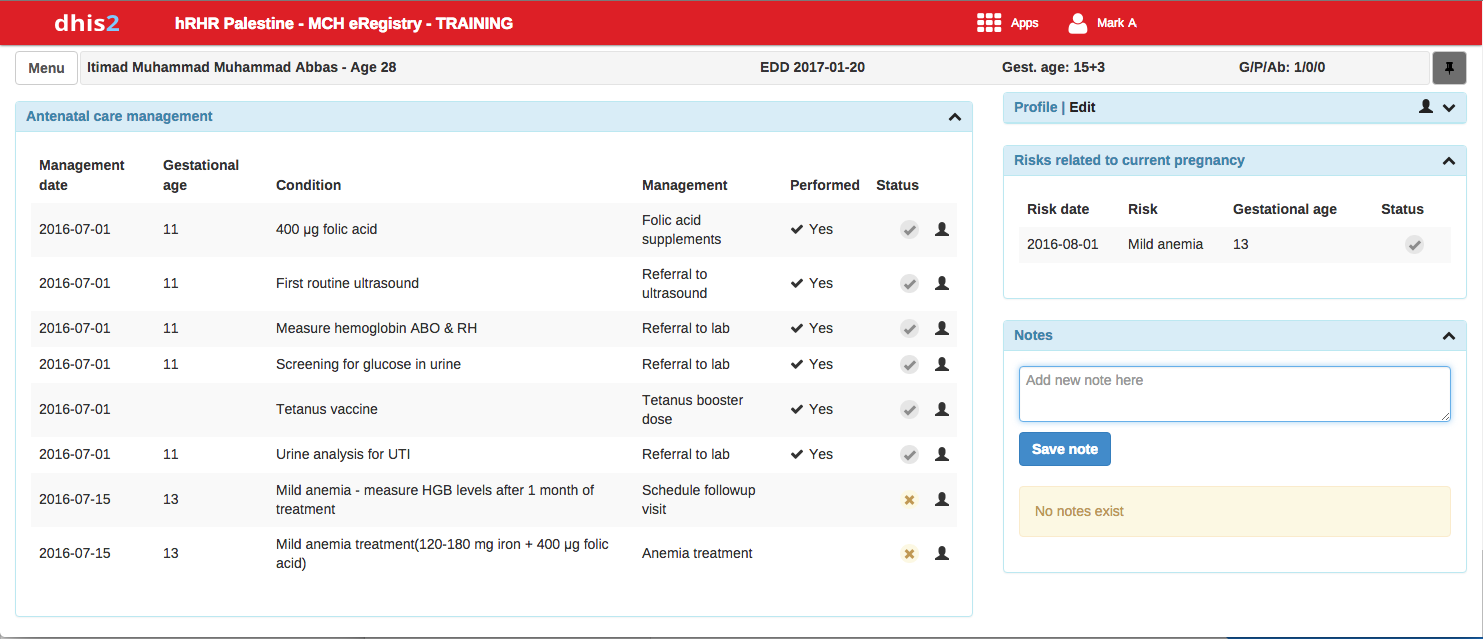

How successful has the program been? We’ve a few hundred cases registered so far with Tracker in the West Bank roll out, so it’s still in its early stages. However, we’ve identified a series of recommendations that may be useful for future DHIS2 Tracker implementations.

What is the general feedback and what are the highlights of this program? It’s been positive on the whole so far. Using a rule-based workflow that is modifiable to match treatment guidelines helped no end. Also, achieving consensus on national standard treatment guidelines and developing proper governance are areas we recommend focusing on. We also believe that designing the system with the users and making the UI customizable are of great value. We recommend reviewing any existing systems and making efforts to integrate with and support them as this might bring long-term benefits.