Integrated Disease Surveillance: Acute Febrile Illness - System Design Document
Introduction
Acute febrile illness (AFI) surveillance systems support public health officials to understand, detect and respond to emerging and reemerging infectious disease threats. Conducting AFI surveillance leads to greater detection of emerging and epidemic-prone infectious diseases that may be unknown, understudied, or difficult to track. Additionally, surveillance systems can support high-priority investigations using available staff, material, supplies, reagents, and testing processes CDC, 2021.developed in partnership with the U.S. Centers for Disease Control and Prevention (CDC), the DHIS2 toolkit for AFI surveillance supports countries to digitize AFI surveillance activities in the national system, with key features such as linking laboratory results to screened and enrolled AFI cases presenting in sentinel surveillance facilities. As part of a multipathogen approach to disease surveillance, the AFI system design promotes coordination across disease monitoring systems, use of a flexible foundation, and dedicated resources for effective disease detection and informed conclusions.
The DHIS2 Tracker program incorporates digital versions of two generic forms from the AFI toolkit: the case report form and the specimen collection and testing form, and links them to a common case record for improved data management and analysis. CDC-recommended metadata are used to enable electronic capture of individual/case-based AFI surveillance data from the point of screening and enrollment in the surveillance study. The tracker is designed for surveillance purposes according to CDC-recommended protocols for AFI surveillance. It is therefore NOT optimized or intended to support individual patient management or patient care. Pre-configured dashboards allow public health staff in countries to monitor AFI results and trends in real-time for as long as the surveillance activities continue.
The system design document explains how the tracker program was configured to meet the data entry and analysis requirements and support a typical workflow. The document does not include an exhaustive listing of all metadata captured. More information on the AFI programme technical aspects informing this system design is available in the AFI toolkit generic protocol, which can be obtained by emailing askgelsb@cdc.gov, with a request expressing interest in receiving the relevant documentation.
Acknowledgements
The AFI toolkit was developed in partnership with CDC Division of Global Health Protection (DGHP) Global Epidemiology, Laboratory, and Surveillance Branch (GELSB). GELSB, in collaboration with CDC country and regional offices, is taking an active role to harmonize AFI surveillance efforts as part of a multi-pathogen approach to disease surveillance and supporting countries to strengthen these systems. HISP Centre is also grateful to the Ministry of Health of Uganda, HISP Uganda and AFENET Liberia for sharing their implementation lessons and system design approaches to inform the development of this toolkit.
Background
Acute febrile illness (AFI) is a common clinical syndrome of a wide variety of pathogens, ranging from treatable and vaccine-preventable infectious diseases to newly emerging pathogens with pandemic potential. AFI is characterized by a rapid onset of fever and other symptoms such as headache, diarrhea, chills, and cough and can be caused by viruses, bacteria, parasites, and fungi. The etiologies (causes) of AFI vary geographically and seasonally and can change over time due to factors such as vaccine use, environmental changes, sanitation, and economic development. Given the similarity of AFI clinical presentations and diversity of potential etiologies, diagnosis is a major challenge in settings with limited laboratory diagnostic capacity. The timely and accurate collection of epidemiologic and laboratory AFI data can identify under-recognized endemic disease burden and distribution, risk factors for infection, and health inequities. The identification of these factors contributes to disease prioritization and rapid detection and response to outbreaks of epidemic potential.
Use case
Depending on country context, AFI systems may be implemented in select hospitals or health centers for a time-bound period or for ongoing surveillance activities. The program serves as an electronic registry that supports decentralized electronic data capture of case surveillance data down to health facility and laboratory levels. The AFI program enables enrollment, case data entry, and case data follow-up from the point of case presentation to facility to final case outcome, inclusive of laboratory results.
This case surveillance package supports one approach to indicator-based surveillance, which is typically characterized as structured information, reported to public health officials mostly from formal sources such as health care providers, following a standardized format or set of indicator definitions (WHO, US CDC).
Workflow
The AFI program has been designed to reflect a generic workflow that is able to integrate data entry both from the health facility (e.g. clinicians and nurses) and the laboratory using the AFI toolkit generic case report form and specimen collection and testing form. The questions and response options on these generic forms will be revised by the implementing country based on the surveillance objectives and country-specific context.
Program configuration
The AFI program has been structured in two different modules:
- Screening aggregate dataset
- AFI tracker program including:
- Case report
- Specimen collection and transport
- Laboratory testing and result
- Patient follow-up and outcome
Having the screening information collected as aggregate data allows the implementer to easily manage a high volume of patients normally present on a screening service granting at the same time the collection of a minimum set of data elements, crucial on the elaboration of key performance indicators.
Besides screening data, all other data are collected according to the below data architecture:

Table 1: Structure and description
| Structure | Description |
|---|---|
| Enrollment | The stage collects the basic TEI attributes. Please note that some of the attributes show the 'GEN - ' prefix. To know more about the Common Metadata Library, please refer to the link provided. The stage is non-repeatable. |
| Case report | The stage collects basic information on the patient's signs and symptoms, exposure and preventive measures. Only one AFI event can be recorded for every TEI. In case of a new AFI even for the same TEI, a new TEI has to be enrolled. The stage is non-repeatable. |
| Specimen collection & transport | The stage collects basic information on specimen collection and transportation. The stage is repeatable in case more than one specimen collection/transportation is required per TEI. |
| Laboratory testing & result | The stage collects basic information on tests performed and pathogens identified. The stage is repeatable in case more than one specimen is processed per TEI. |
| Patient follow-up & outcome | The stage collects basic information related to diagnosis. The stage is non-repeatable as only one AFI event per TEI. |
Note
Several Data Elements and Option Set have been kept generic as highly implementation/country dependant (more details on the Stage Detail section) and can be identified with the prefix '[CONFIG]_'
Intended users
Through a collaborative process of working with implementing countries and surveillance stakeholders at multiple levels of the health system, the following have been identified as potential users of an AFI surveillance data entry and management platform in DHIS2:
- Health facility staff or surveillance officers: AFI surveillance staff at identified surveillance sites (hospitals, clinics, etc.) will be responsible for completing case data entry based on the predetermined sampling framework and inclusion/exclusion enrollment criteria
- Public health staff: monitor and analyze surveillance data being collected using the DHIS2 system; receive alerts for potential disease outbreaks generated by the system; analyze surveillance data for trends that may indicate possible disease outbreaks and plan response activities where appropriate.
- Laboratory staff: monitor specimen tracking; may be involved in entering or uploading laboratory results to case record.
Dataset / Stages details
Screening

A daily periodicity was assigned to the dataset in order to support a proper and optimal follow-up of the main key performance indicator (KPI) related to the screening stage but should be assessed and customized according to the implementation context.
Tracker program structure
Enrollment
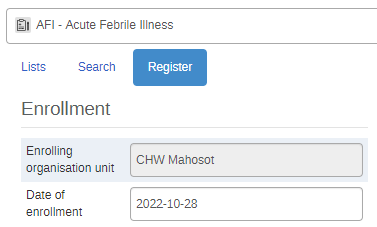
When a patient is enrolled in the AFI program as a Tracked Entity Instance (TEI), Tracked Entity Attributes (TEA) are recorded to form the case profile.
The Enrollment date is used as the date of first consultation of the case both at OPD (Outpatient Department) or IPD (Inpatient Department); meanwhile the data entry date should be reported on the 'Report date' present on each stage.
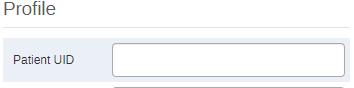
The patient UID has been kept empty as the codification is country/implementation dependent. The patient UID is a mandatory field that will be unique to each AFI case being enrolled. Here you can find more information related to automatically generated tracked entity attributes.
The date of birth and age can be assigned in two different ways:
- Known date of birth: select the Date of birth
- Unknown date of birth: select the Date of birth - Unknown option and then enter the age either in years or months.
Once done, a 'probable' age of birth is assigned to the Date of birth based on the value entered either on the years or month TEA.

Note
The Date of birth will always have a value as it's used in the calculation of the program indicators involving age groups.
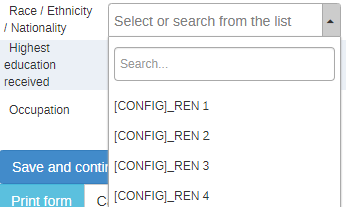
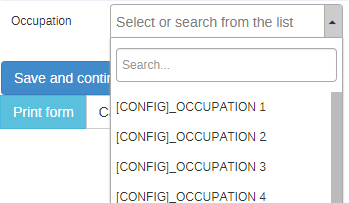
The Options Sets assigned to the TEA of Race / Ethnicity / Nationality and Occupation have been kept general as these options are dependent on context implementation. These will need to be customized prior to implementation.
Case report
This stage is not repeatable as a TEI can be assigned only one AFI event (see Table 1).
In this stage, a multi-option selection of data elements and options set has been implemented in the sections:
- Vaccines previously received
- Animal exposure
- Environmental and other exposure
- Travel history
DHIS2 does not yet have a core, multi-option selection functionality, thus an adaptation was done with:
- Duplication of data elements eligible for multi-option choice (The number of copies of the data element has to be the same as the amount of Options present on the Option Set)
- Program Rules:
- Hide the consequent Data Elements if the previous have not been selected
- Show error in case the same Option has been selected more than once in the same group of Data Elements
In the Environmental and other exposure section, three generic Other exposure data elements have been included and may be used as needed when completing the case CRF.
Specimen collection and transport
This stage is repeatable as multiple sample can be collected and sent in different times
Basic information related to the specimen collection and transport (collector name and date/time of collection) and type of sample are collected on this stage.
Laboratory testing & result
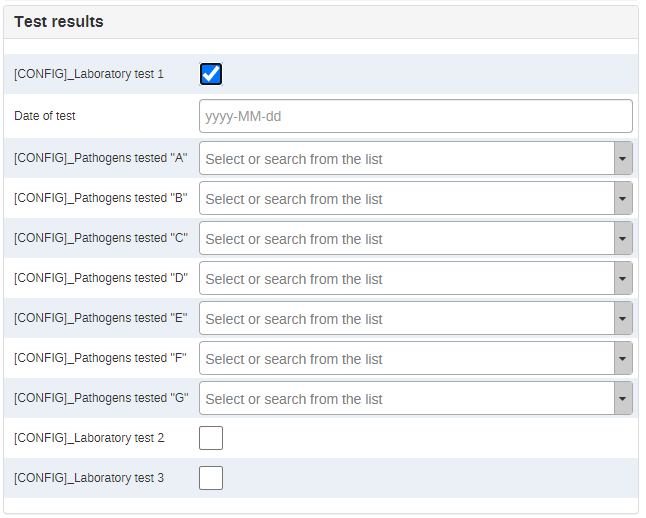
In this stage all the information related to Laboratory test and Pathogen tested have been kept generic as the testing will be dependent on the implementation context (which pathogens and tests have been selected for AFI activities). These need to be customized prior to implementation.
The Date of test has to be provided for each test. The purpose of this is to assign the test event to the right period of time in analytics, and help monitoring the delay between reception and result dates.
Patient follow-up & outcome
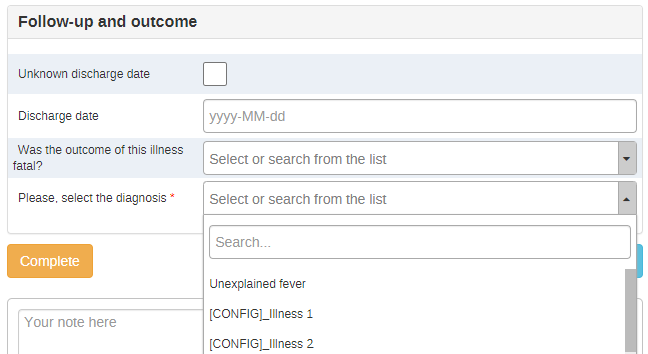
The Discharge date and Unknown discharge date refer to the hospitalization and will be shown only in case the hospitalization have been selected on the Case report section
The Diagnosis options have been kept generic (except for Unexplained fever) and need to be customized prior to implementation
Dashboards and indicators
Dashboards
The program includes two separate dashboards:
- AFI.01 - Case investigation
- AFI.02 - Surveillance overview
AFI.01 - Case investigation
The primary aim of the Case Investigation dashboard is to monitor and analyze real-time case-level data that is collected through AFI surveillance efforts. Enrollment data and information from the Case Report Form and specimen collection and testing form, such as patient demographics, clinical information, specimen collection, and laboratory results, are displayed here.

AFI.02 - Surveillance overview
The primary aim of the Surveillance dashboard is to allow those implementing AFI surveillance activities to efficiently monitor and evaluate real-time aggregate-level data that is collected through AFI surveillance efforts. High level screening and enrollment data are displayed here, with the option to filter by health facility for more in-depth activity tracking.

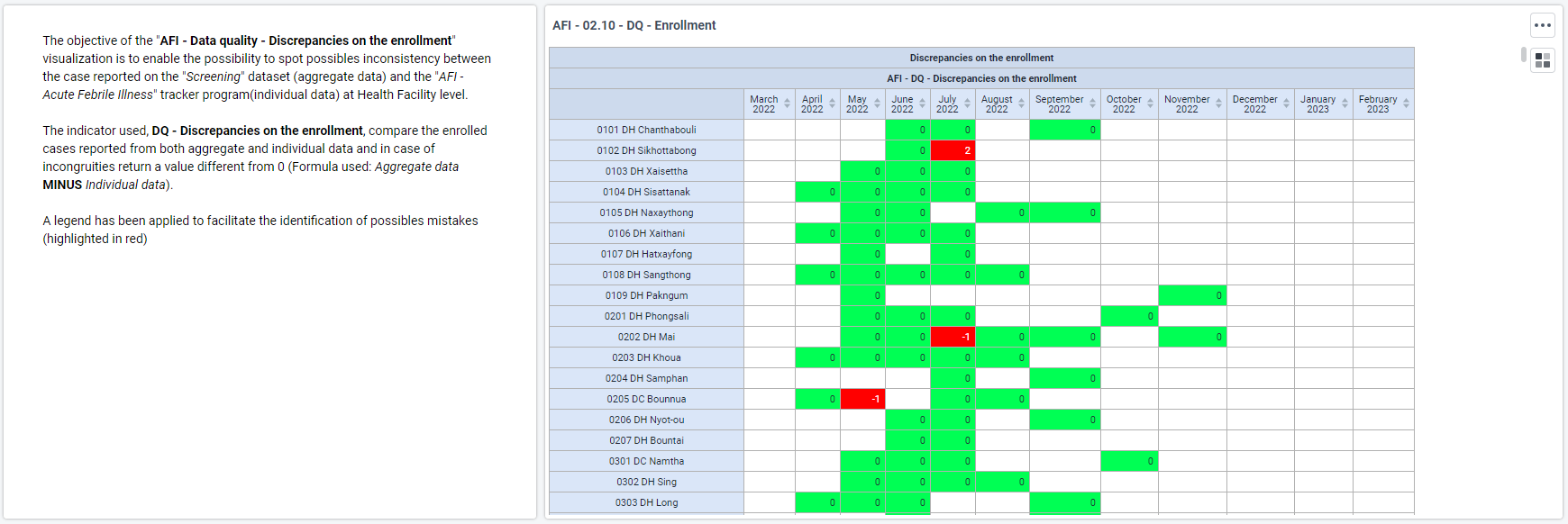
The objective of the "AFI - Data quality - Discrepancies on the enrollment" visualization is to enable the possibility to spot possibles inconsistency between the case reported on the 'Screening' dataset (aggregate data) and the 'AFI - Acute Febrile Illness' tracker program(individual data) at Health Facility level.
The indicator used, DQ - Discrepancies on the enrollment, compares the enrolled cases reported from both aggregate and individual data and in case of incongruities return a value different from 0 (Formula used: Aggregate data ++MINUS++ Individual data).
Indicators / Program Indicators
Hereunder you can find a list of the main indicators used on the visualisations goruped by topic:
| Topic | Indicators |
|---|---|
| Program monitoring | Patients screened Patients eligible for enrollment Patients enrolled Non-hospitalized patients Hospitalized patient |
| Patient characteristics | Age at enrollment (by age group) Sex |
| Signs and symptoms | Average number of days of delay between onset of symptoms and presentation to facility Symptoms Average temperature |
| Exposure | Animal exposure Enviromental exposure Travel exposure |
| Laboratory | Blood & serum sample collected Blood & serum sample accepted Blood & serum sample acceptancy Laboratory test performed |
| Infections details | Patients with no pathogen identified Patients with monoinfection Patients with Coinfections Pathogens tested |
| Data Quality | Discrepancies on the enrollment |
User groups
| User group | Dashboard | Program Metadata | Program data |
|---|---|---|---|
| AFI - Access | Can view | Can view only | Can view only |
| AFI - Admin | Can edit and view | Can edit and view | No access |
| AFI - Data capture | No access | Can view only | Can capture and view |
References
The CDC-supported AFI toolkit can be obtained by emailing askgelsb@cdc.gov, with a request expressing interest in receiving the materials.
US CDC (2022). CDC Leverages Acute Febrile Illness Surveillance System to Respond to COVID-19 https://www.cdc.gov/globalhealth/healthprotection/fieldupdates/2021/UFTF-AFI-Surveillance-COVID-Central-America.html#:~:text=AFI%20is%20characterized%20by%20a,bacteria%2C%20parasites%2C%20and%20fungi.
WHO Regional Office for Africa (2019). Technical guidelines for integrated disease surveillance & response in the WHO AFRO Region. Retrieved from: https://apps.who.int/iris/bitstream/handle/10665/325015/WHO-AF-WHE-CPI-05.2019-eng.pdf
US CDC (2021). Global Disease Detection Operations Center: Overview. Retrieved from: https://www.cdc.gov/globalhealth/healthprotection/gddopscenter/how.html