DHIS2 jako datový sklad
This chapter will discuss the role and place of the DHIS2 application in a system architecture context. It will show that DHIS2 can serve the purpose of both a data warehouse and an operational system.
Datové sklady a operační systémy
A data warehouse is commonly understood as a database used for analysis. Typically data is uploaded from various operational / transactional systems. Before data is loaded into the data warehouse it usually goes through various stages where it is cleaned for anomalies and redundancy and transformed to conform with the overall structure of the integrated database. Data is then made available for use by analysis, also known under terms such as*data mining*and online analytical processing. The data warehouse design is optimized for speed of data retrieval and analysis. To improve performance the data storage is often redundant in the sense that the data is stored both in its most granular form and in an aggregated (summarized) form.
A transactional system (or operational system from a data warehouse perspective) is a system that collects, stores and modifies low level data. This system is typically used on a day-to-day basis for data entry and validation. The design is optimized for fast insert and update performance.

There are several benefits of maintaining a data warehouse, some of them being:
-
Consistency: It provides a common data model for all relevant data and acts as an abstraction over a potentially high number of data sources and feeding systems which makes it a lot easier to perform analysis.
-
Reliability: It is detached from the sources where the data originated from and is hence not affected if data in the operational systems are purged or lost.
-
Analysis performance: It is designed for maximum performance for data retrieval and analysis in contrast to operational systems which are often optimized for data capture.
There are however also significant challenges with a data warehouse approach:
-
High cost: There is a high cost associated with moving data from various sources into a common data warehouse, especially when the operational systems are not similar in nature. Often long-term existing systems (referred to as legacy systems) put heavy constraints on the data transformation process.
-
Data validity: The process of moving data into the data warehouse is often complex and hence often not performed at regular and timely intervals. This will then leave the data users with out-dated and irrelevant data not suitable for planning and informed decision making.
Due to the mentioned challenges, it has lately become increasingly popular to merge the functions of the data warehouse and operational system, either into a single system which performs both tasks or with tightly integrated systems hosted together. With this approach, the system provides functionality for data capture and validation as well as data analysis and manages the process of converting low-level atomic data into aggregate data suitable for analysis. This sets high standards for the system and its design as it must provide appropriate performance for both of those functions; however, advances in hardware and parallel processing is increasingly making such an approach feasible.
In this regard, the DHIS2 application is designed to serve as a tool for both data capture, validation, analysis and presentation of data. It provides modules for all of the mentioned aspects, including data entry functionality and a wide array of analysis tools such as reports, charts, maps, pivot tables and dashboard.
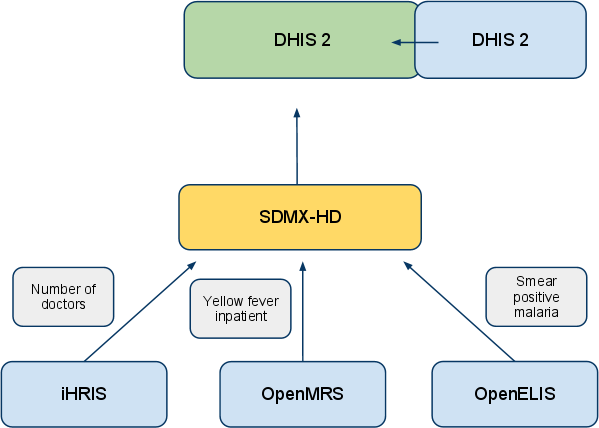
In addition, DHIS2 is a part of a suite of interoperable health information systems which covers a wide range of needs and are all open-source software. DHIS2 implements the standard for data and meta-data exchange in the health domain called SDMX-HD. There are many examples of operational systems which also implements this standard and potentially can feed data into DHIS2:
-
iHRIS: System for management of human resource data. Examples of data which is relevant for a national data warehouse captured by this system is "number of doctors", "number of nurses" and "total number of staff". This data is interesting to compare for instance to district performance.
-
OpenMRS: Medical record system being used at hospital. This system can potentially aggregate and export data on inpatient diseases to a national data warehouse.
-
OpenELIS: Laboratory enterprise information system. This system can generate and export data on number and outcome of laboratory tests.
Strategie agregace v DHIS2
The analysis tools in DHIS2 read aggregated data from data mart tables. A data mart is a data store optimized for meeting the most common user requests for data analysis. The DHIS2 data mart contains data aggregated in the*space dimension* (the organisation unit hierarchy), time dimension (over multiple periods) and for indicator formulas (mathematical expressions including data elements). Retrieving data directly from data marts provides good performance even in high-concurrency environments since most requests for analysis can be served with a single, simple database query against the data mart. The aggregation engine in DHIS2 is capable of processing low-level data in the multi-millions and managing most national-level databases, and it can be said to provide near real-time access to aggregate data.
DHIS2 allows for setting up scheduled aggregation tasks which typically will refresh and populate the data mart with aggregated data every night. You can choose between aggregating data for the last 12 months every night, or aggregate data for the last 6 months every night and the last 6 to 12 months every Saturday. The scheduled tasks can be configured under "Scheduling" in "Data administration" module. It is also possible to execute arbitrary data mart tasks under "Data mart" in "Reports" module.
Přístup k ukládání dat
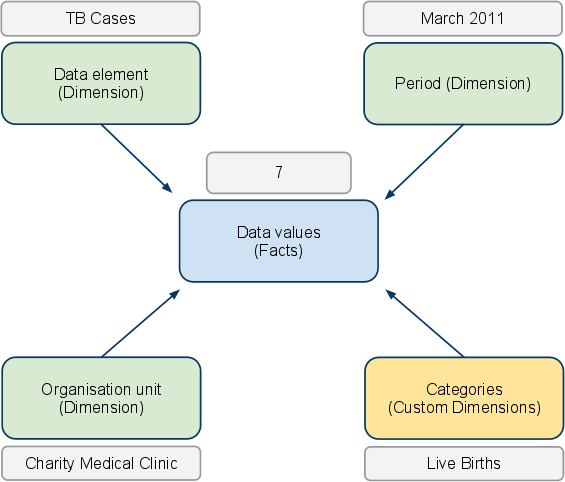
There are two leading approaches for storing data in a data warehouse, namely the normalized and dimensional approach. DHIS2 lends a bit from the former but mostly from the latter. In the dimensional approach, the data is partitioned into dimensions and facts. Facts generally refer to transactional numeric data while dimensions are the reference data that gives context and meaning to the data. The strict rules of this approach make it easy for users to understand the data warehouse structure and provides for good performance since few tables must be combined to produce meaningful analysis, while it, on the other hand, might make the system less flexible and harder to change.
In DHIS2 the facts correspond to the data value object in the data model. The data value captures data as numbers, yes/no or text. The compulsory dimensions which give meaning to the facts are the data element, organisation unit hierarchy and period dimensions. These dimensions are referred to as compulsory since they must be provided for all stored data records. DHIS2 also has a custom dimensional model which makes it possible to represent any kind of dimensionality. This model must be defined prior to data capture. DHIS2 also has a flexible model of groups and group sets which makes it possible to add custom dimensionality to the compulsory dimensions after data capture has taken place. You can read more about dimensionality in DHIS2 in the chapter by the same name.