Nutrition - System Design Document
Background and Purpose
Balíček digitálních dat Výživa (NUT) byl vyvinut ve spolupráci s UNICEF jako reakce na vyjádřenou potřebu zemí rychle přizpůsobit řešení pro správu dat pocházejících z plánovaných/uskutečněných nutričních aktivit. Balíček agregovaných metadat NUT byl proto navržen jako instalovatelné řešení pro země, aby aktualizovaly svůj HMIS založený na DHIS2 podle aktualizované verze pokynů UNICEF.
Tento dokument Návrh souhrnného systému NUT poskytuje přehled principů návrhu a globální technické pokyny používané k vývoji standardního balíčku metadat pro monitorování aktivit NUT na úrovni zařízení a komunity. Balíček metadat NUT lze přizpůsobit místním potřebám a národním směrnicím.
Tento dokument je určen k použití implementátory DHIS2 na úrovni země a regionu, aby bylo možné podporovat implementaci a lokalizaci konfiguračního balíčku při dodržení stanovených zásad návrhu.
Případ použití
Balíček NUT byl navržen pro sběr dat a analýzu běžných výživových činností prováděných v zařízeních i v komunitě.
Doporučuje se, aby datové soubory NUT (zařízení a komunita) byly přiřazeny organizačním jednotkám na nejnižší úrovni zdravotnického systému, která je pro vykazování dat proveditelná.
Soubor údajů o populaci by měl být místo toho přiřazen podle místní úrovně agregace údajů o populaci.
Jak a kde získat jmenovatel související s odhadovanou populací dětí se středním a těžkým chřadnutím, stejně jako na jaké úrovni se jmenovatel provádí, velmi závisí na místním kontextu. Země by proto měly přiřadit soubor údajů na příslušnou administrativní úroveň v hierarchii systému, aby co nejlépe odrážely místní tok informací.
Určení uživatelé
- Uživatelé zdravotnických zařízení a komunitní poskytovatelé zdravotních služeb: zachycujte a oznamujte klíčová data o aktivitách NUT prezentovaných na úrovni zdravotnického zařízení a komunity
- Programoví manažeři: manažeři na národní a nižší než národní úrovni mohou být zodpovědní za podporu zadávání dat a analýzy.
- Národní a místní zdravotnické úřady: monitorovat a analyzovat dohled nad daty prostřednictvím ovládacích panelů a analytických nástrojů, provádět hodnocení rizik a plánovat opatření reakce; generovat zprávy pro regionální a globální zprávy
Přehled návrhu systému
Package Structure
Souhrnný balíček NUT je strukturován takto:
| Datová sada | Periodicita | Popis |
|---|---|---|
| Událost Nutrition VAS | Šestiměsíční | Aktivity doplnění vitaminu A spojené s jednorázovou hromadnou událostí konající se jednou za půl roku buď na úrovni komunity nebo zařízení. |
| Výživová komunita | Měsíčně | Uvádí aktivity NUT (doplňování mikroživin / Výživa kojenců a malých dětí / Mateřské poradenství / Sledování růstu a podpora a chřadnutí), které se vyskytují v komunitě s HCW. |
| Výživové zařízení | Měsíčně | Reports the NUT activities (Micronutrient supplementation / Infant and Young Child Feeding / Maternal counselling / Growth Monitoring & Promotion and Wasting) occurring at health facility level. |
| Výživa populace | Ročně | Stručný soubor základních demografických datových bodů. |
| ### Datové prvky { #data-elements } |
Úplný seznam datových prvků je k dispozici v referenčním souboru metadat.
NOTE:
Please note, that the DE groups have been named after the NUT activities rather than after the datasets - i.e. datasets may contain DEs that belong to several DEGs. Moreover, some DEs may be shared between datasets.
Dataset Details
As the datasets are organized by activities rather than as a full program, some DEs might appear as repeated in different sections within the same datasets. Implementers should keep in mind that these should be adapted according to the local organization of the nutrition program - are CHWs / HWs managing all the activities transversally (i.e. the same worker takes care of counselling as much as ANC contacts and supplements)? Are the activities distributed among different workers (i.e. some workers only do counselling while others take care solely of ANC/PNC or of the nutritional screening of the children)? Depending on the distribution of the tasks, the variables should be arranged accordingly to prevent double data entry for the same information.
Nutrition VAS Event Dataset Details
Tento soubor dat shromažďuje údaje o aktivitách suplementace vitaminem A v zařízeních i komunitách. Suplementace vitaminu A se měří po dobu půl roku, a to buď pomocí rutiny nebo kampaní (známých jako události) nebo kombinací obojího. Toto je definováno jako semestr. V analýze, konkrétně pro výpočty indikátorů, je třeba data číst pouze jako 6měsíční semestr nebo měsíční hodnotu. Nepokoušejte se použít semestrální pokrytí k odhadu ročního pokrytí, jmenovatel není stejný jako pro semestr. GAVA (Globální aliance pro suplementaci vitaminu A) vyžaduje, aby byly zaznamenány 2 hodnoty pro každé půlroční období a aby se k vyjádření pokrytí daného roku použila NIŽŠÍ z těchto dvou hodnot. V DHIS2 to v současnosti není možné automaticky vypočítat.
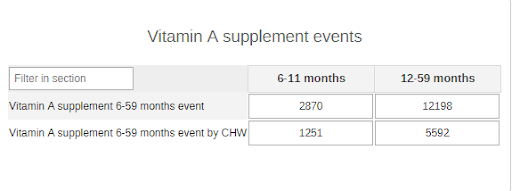
Tato sekce a datový soubor shromažďuje informace týkající se jednorázových (událostních) distribučních aktivit vitaminu A a doplňků distribuovaných dětem a doplňků distribuovaných CHW. Vzhledem k tomu, že vitamin A je často distribuován ve zdravotnických zařízeních během kampaní, byly tyto dva datové prvky speciálně navrženy tak, aby oddělily doplňky distribuované WHO: sestry/lékaři/lékárníci vs. komunitní zdravotníci.
Nutrition Community Dataset
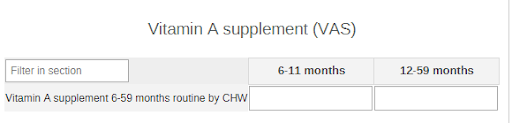
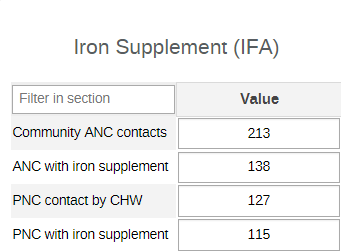
Sekce se zaměřuje na předporodní kontakty a čerstvé matky, které dostávají doplňky obsahující železo na komunitní úrovni. Distribuce VAS v tomto datovém souboru zohledňuje rutinní události, které se pravidelně dějí na úrovni komunity.
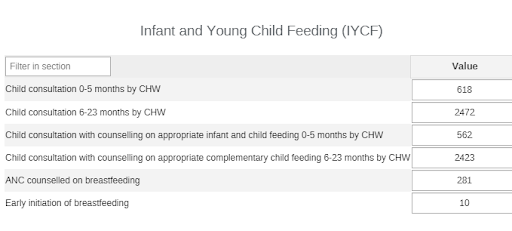
The table considers children under 24 months visited at community level and the counselling consultations that have been given to their caregivers/mothers. The second part of the table focuses on the antenatal contacts counselled on breastfeeding during the usual ANC contacts at community level.
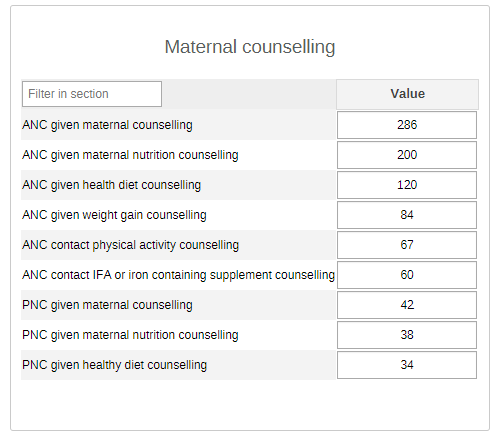
Sekce se zaměřuje na poradenská sezení poskytovaná matkám o jedinečném zdravotním stavu matky, která má být sama sebou/novou matkou během ANC a PNC v komunitě.
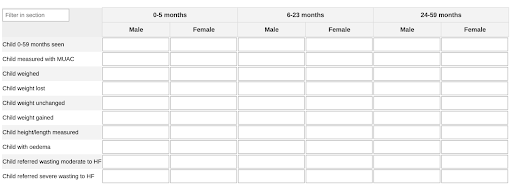
The section groups the routine screening performed on children during nutrition-related consultations (MUAC measurements, height/length and weight measurements) by age groups and sex. It also provides an aggregate overview of children who have lost or gained weight, or whose weight remained unchanged since the last contact. Finally, the section also reports the children with moderate and severe wasting referred for further evaluation and care.
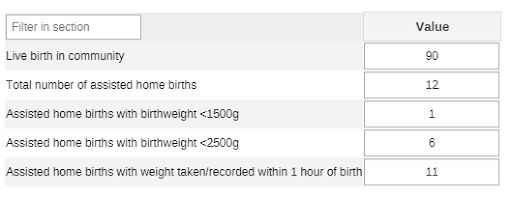
The second part of the section summarizes the births occurring in the community and the weights of the newborns. Please note that the original purpose of the weight thresholds present in the data elements (1500 g and 2500 g) was to be mutually exclusive - i.e. "Assisted home births with birthweight <1500g" should report for all the newborns with a weight below 1500 g, while "Assisted home births with birthweight <2500g" should report for all the newborns with a weight between 1501g and 2500g. Depending on the feasibility of the activity in the community, the reporting should at least try to include the newborns with a weight below 2500 g excluding the 1500g threshold.
Nutrition Facility Dataset
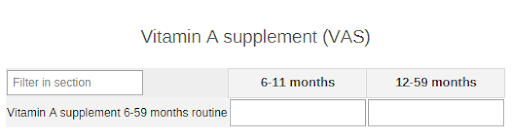
Sekce shromažďuje informace o běžném podávání doplňků Vitamínu A dětem U5 6-59 měsíců na úrovni zařízení.
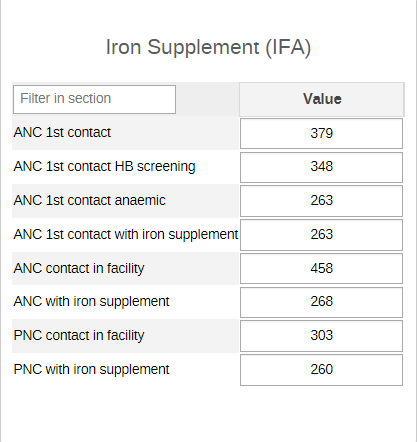
Sekce shromažďuje údaje o screeningu Hb a anémii během aktivit ANC a suplementaci obsahující železo během návštěv ANC a PNC na úrovni zařízení.
Infant and Young Child Feeding (IYCF)
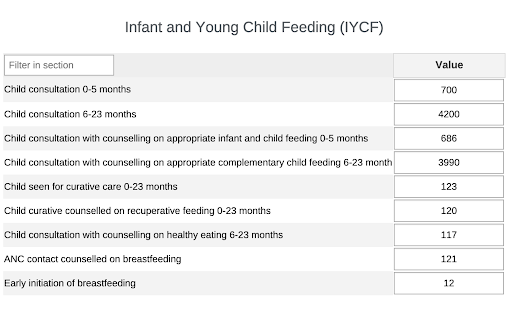
The table considers the children under 24 months visited in the facilities and the counselling consultations that have been given to their caregivers/mothers. The second part of the table focuses on pregnant mothers counseled on breastfeeding during the usual ANC contacts in facility.
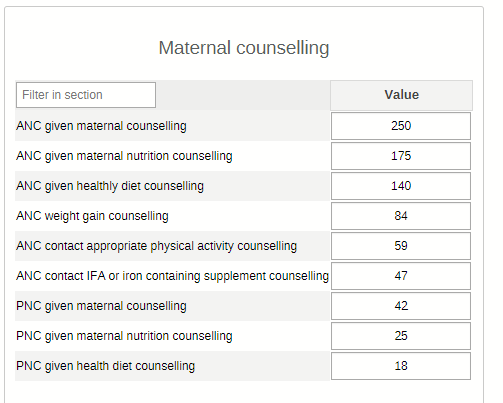
Sekce se zaměřuje na poradenská sezení poskytovaná matkám o jedinečném zdravotním stavu matky, která má být sama sebou/novou matkou během ANC a PNC na úrovni zařízení.
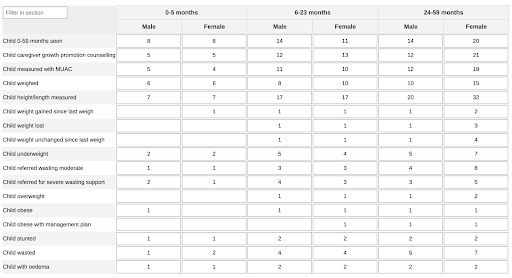
The section gathers all the DEs related to the nutritional screenings (weight fluctuations, MUAC measurements, referrals for moderate and severe wasting, etc) of the children presenting at facility level. THe weight change should be interpreted with refefrence to the previous visit.
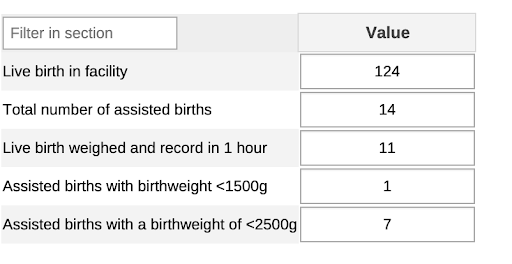
The second part of the section summarizes the births occurring in the facility and the key information on birth weights of the newborns. Please note that the original purpose of the weight thresholds present in the data elements (1500 g and 2500 g) was to be mutually exclusive - i.e. "Assisted births with birthweight <1500g" should report for all the newborns with a weight below 1500 g, while "Assisted births with birthweight <2500g" should report for all the newborns with a weight between 1501g and 2500g. Depending on the feasibility of the activity in the community, the reporting should at least try to include the newborns with a weight below 2500 g excluding the 1500g threshold.
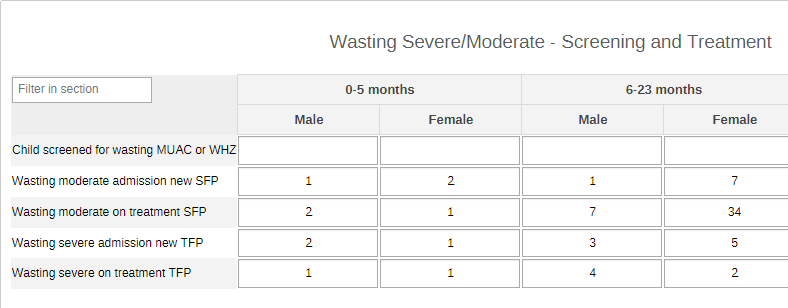
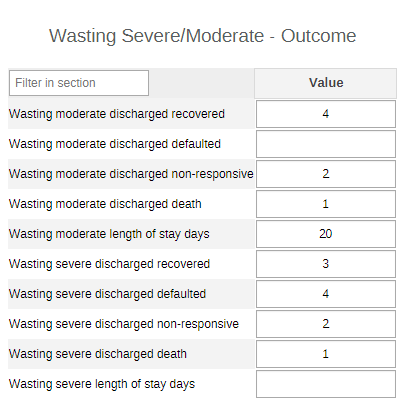
The section collects the information on children with wasting (severe or moderate by age groups and sex) and their admissions to feeding programs.
NOTE
It has not been included in the core configuration for version 1.0.0., but the section could be further disaggregated by admission criteria (admission by MUAC and admission by WHZ) if needed.
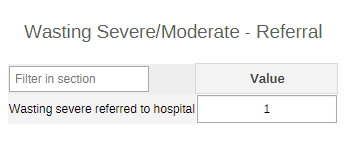
This section reports on referral of children with severe wasting that are referred to a hospital. This referral usually occurs due to medical complications
Nutrition Population Dataset
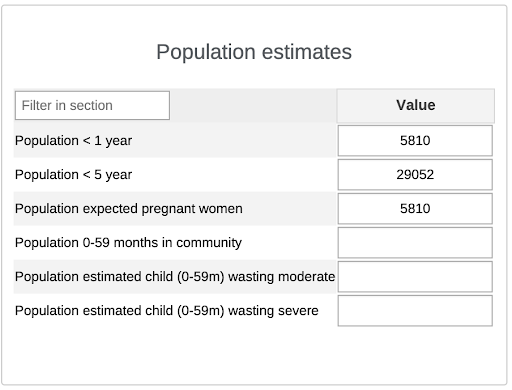
The dataset collects very basic demographic data for the calculation of population-based prevalence within the NUT activities. As aforementioned, the source of the denominators and assignation of the dataset to the admin level is very much dependent on the local context and should therefore be kept into consideration during the implementation of the package. The "Population < 1 year" and "Population < 5 years" should be adapted to the local availability of population data - if available, the DEs should be treated as mutually exclusive reporting respectively the children between 0 and 11 months, and the children between 12 and 59 months. If unavailable, implementers should either rely on estimates or at least report the population under 5 years of age. Again, depending on the availability of population data, the first two DEs in the table could be representative of just facility-based data or come from facility estimates, while the "Population 0-59 months in community" could be used for the community population in the catchment area. Overall, given the difficulty to handle population data, implementers should at least have one estimate of children 0-59 months that could work for the facility and the community served by that facility.
Pravidla ověření
Validation rules have also been grouped by activity rather than datasets. All rules have been set with a monthly periodicity. The VR group is called NUT - Nutrition. The full list of validation rules is available in the metadata reference file.
Skupiny uživatelů
V rámci konfigurace balíčku byly vytvořeny skupiny uživatelů, které se používají ke správě nastavení sdílení v metadatech pro všechny moduly. Mezi základní metadata, která používají tato nastavení sdílení, patří zejména datové sady, řídicí panel, indikátory a datové prvky. Mezi 3 vytvořené uživatelské skupiny patří:
- NUT admin - users in this group will have sharing setting with view/edit access metadata and view only access to data values in dataSets
- NUT access - users in this group will have sharing setting with view only access to metadata and data values in dataSets
- NUT data capture - users in this group will have sharing setting with view only access to metadata and edit access to data values in dataSets
I když je důležité tyto userGroups při instalaci tohoto balíčku udržovat, můžete je zkontrolovat v souladu s jakýmkoli existujícím nastavením nebo zásadou userGroups v instanci hostitele.
Analytics and Indicators
Just like the data element groups, the indicators groups are divided by activities rather than by datasets. Moreover, the indicator groups are further divided by “core” and “additional” to indicate whether the indicators are part of the compulsory set of indicators, or whether the indicators are optional:
- Maternal Counselling (Core)
- Vitamin A supplement (Core)
- Wasting - Severe/Moderate (Core)
- Iron Supplement (Core)/Iron Supplement (Additional)
- Infant and Young Child Feeding (Core)/Infant and Young Child Feeding (Additional)
- Growth monitoring and promotion (Core)/Growth monitoring and promotion (Additional)
Úplný seznam indikátorů je k dispozici v referenčním souboru metadat.
Ovládací panely
Balíček NUT obsahuje tři předdefinované ovládací panely:
-
NUT - Community
-
NUT - Facility
-
NUT – Zařízení a komunita
NOTE
Please note that the dashboards are preconfigured to provide the users a baseline onto which to build the local dashboards. Users >can edit (remove and add) items and their configuration - change the visualization depending on the disaggregations used, change the >time of analysis depending on the chosen periodicity of the datasets, or change the types of graphs just to name a few examples.
Položky navržené v předkonfigurovaných ovládacích panelech jsou dostupné v referenčním souboru metadat.
Special Considerations: Nutrition and Community
The need to align the efforts to enhance community programmes and their data is one of the paramount priorities for the effective analysis of community needs and activities. While the Community dataset of the NUT package supports the collection of nutrition-related data at community level, the DHIS2 Community Health Information Systems (CHIS) metadata package is also designed to facilitate the capture and analysis of a core set of indicators for community-based health services. The CHIS metadata package developed in collaboration with UNICEF accompanies the WHO Analysis and Use of Community Data: Guidance for community health service monitoring. Among the range of health areas covered in the modules of the CHIS package, Nutrition information can be collected at monthly and yearly intervals.
Pokud mají uživatelé balíčky NUT i CHIS ve stejné instanci, mohou použít tabulku k porovnání těchto dvou balíčků a pozorovat paralely a rozdíly, aby mohli vybrat datovou sadu, která lépe odráží místní aktivity.
The NUT/CHIS summary table provides an overview of the alignment of the DEs present in the NUT - Community and in the CHIS - Nutrition datasets.
Následující sekce a DE v balíčku NUT se přímo nepřekrývají s datovým souborem CHIS - Výživa:
| Sekce | DEs - Název formuláře |
|---|---|
| Maternal counselling | ANC given maternal counselling ANC given maternal nutrition counselling in community ANC given health diet counselling ANC given weight gain counselling ANC given physical activity counselling ANC given IFA or iron containing supplement counselling PNC given maternal counselling PNC given maternal nutrition counselling PNC given healthy diet counselling |
| Krmení kojenců a malých dětí (IYCF) | PNC kontakty - vše |
| Monitorování a podpora růstu | Child weight lost Child weight unchanged Child gained weight Child referred for moderate wasting support to health facility by CHW |
Some of the CHIS sections and DEs also do not directly overlap with any of the DEs in the NUT - Community dataset:
| Datová sada | Sekce | DEs - Název formuláře |
|---|---|---|
| Měsíčně | Breastfeeding and birth weight | Novorozenci narození v komunitě a přiložení k prsu během první hodiny po porodu Novorozenci s doloženou porodní hmotností Novorozenci s nízkou porodní hmotností |
| Měsíčně | Odčervení | Lidé cílení na odčervovací preventivní chemoterapii Lidé podstupující odčervovací preventivní chemoterapii Lidé podstupující odčervovací preventivní chemoterapii |
| Měsíčně | Vitamin A supplementation - events | Children (6-59m) attending Vit A event in semester 1 Children (6-59m) given Vit A by CHW in semester 1 event Children (6-59m) attending Vit A event in semester 2 Children (6-59m) given Vit A by CHW in semester 2 event |
| Měsíčně | Těžká akutní podvýživa (SAM) | Children (6-59m) assessed for SAM Children (6-59m) with SAM |
| Měsíčně | Wasting | Children (6-59m) in the community |
| Měsíčně | Diarrhoea | Children aged 0-9 years presenting with diarrhoea who received treatment Children (0-9 y) treated for diarrhoea |
| Ročně | Body weight | Children (5-19 y) overweight and obese |
| Ročně | Overweight (0-4 y) | Děti (0-4 roky) s nadváhou |
| Ročně | Obezita (5-19 let) | Children (5-19 y) overweight and obese |
| Ročně | Ženy a dospívající dívky s podváhou | Consultations non-pregnant women and adolescent girls Underweight women |
Data Triangulation Facility and Community
Should the users decide to collect the community data on nutrition with the CHIS - Nutrition dataset while using the NUT - Facility dataset for the health facility data, they will have to adapt the dashboard triangulating the community and the health facility nutrition data (NUT - Nutrition facility and community) The table below provides the CHIS indicators, if present, that can be used to replace the NUT indicators referring to community activities.
| Graph/Table title | NUT indicator | CHIS indicator |
|---|---|---|
| NUT - ANC breastfeeding counselling community and facility (%), last 6 months | NUT - Antenatal client breastfeeding counselling in community (%) | CH036 - ANC visits with breastfeeding counselling (%) |
| NUT - IYCF counselling 0-5 months facility and community (%), last quarter | NUT - IYCF counselling 0-5 months in community (%) | CH058 - Consultations for children (0-5 m) with feeding counselling (%) |
| UT - IYCF counselling 6-23 months facility and community (%), last quarter | NUT - IYCF counselling 6-23 months in community (%) | CH059 - Consultations for children (6-23 m) with feeding counselling (%) |
| NUT - ANC všechny podávané doplňky obsahující železo v zařízení a komunitě (%), posledních 6 měsíců | OŘECH – předporodní kontakt s doplňkem obsahujícím železo v komunitě (%) | CH037 - Women given/prescribed iron supplements during ANC (%) |
| NUT - PNC všechny podávané doplňky obsahující železo v zařízení a komunitě (%), poslední čtvrtletí | NUT - Postnatal contact all visits given iron containing supplement in community (%) | There is no direct correspondence to a CHIS indicator for PNC iron supplementation in the Nutrition module. |
| NUT - Vitamin A supplement 6-59 months routine and events facility and community, last 4 semesters | NUT - Vitamin A supplement 6-59 months routine by CHW NUT - Vitamin A supplement 6-59 months event by CHW | CH061b - Children (6-59m) given Vit A each semester event(%) This is the only predefined indicator for the Vit A supplementation. The dataset contains all the necessary DEs to build two CHIS indicators overhauling with the two NUT indicators. |
| Maternal counselling section of the dashboard | NUT - Antenatal contacts given maternal nutrition counselling in community (%) | U čistě mateřských poradenských aktivit v modulu Výživa neexistuje přímá shoda s indikátory CHIS. |
| NUT - Height measurement in facility and community, last 6 months | NUT - Child height/length for age measurement in community (%) | CH067 - Děti (0-4 roky) s naměřenou výškou (%) |
| NUT - Weight measurement in facility and community, last 6 months | NUT – Měření hmotnosti dítěte v komunitě (%) | CH064 - Children (6-59 m) weighed There is no proportion preconfigured in the CHIS-Nutrition dataset but can be configured by cloning indicator CH064 and setting DE CH067b as denominator. |
| NUT - MUAC measurement in facility and community, last quarter | NUT - Child MUAC measurement in community (%) | There is no direct correspondence to CHIS indicators for MUAC-only indicators - more info in the tables in section 9. |
Android Compatibility
Digital data packages are optimized for Android data collection with the DHIS2 Capture App, free to download on the GooglePlay store. Key considerations in design was to ensure that all forms are configured with sections that structure form layout for better display on the Android devices. Also, with the requirement of minimal data disaggregation in this package, all the dataSet layout should provide a concise view for Android display.
Reference
UNICEF (November 2021). Strengthening Nutrition Information Systems URL: https://data.unicef.org/resources/strengthening-nutrition-information-systems/ Guidelines and links will be available soon.