HFP - Health Facility Profile
Úvod
The Health Facility Profile (HFP) toolkit focuses on implementing integrated, people-centred health facility profiles, providing a comprehensive overview of main healthcare facility's resources, services, and performance indicators.
The World Health Organization (WHO) recognizes the importance of monitoring trends and evaluating progress in healthcare facility management by collecting relevant data through national health information systems. Routine data collected from health facilities, as facilitated by the Health Facility Profile toolkit, offer insights into service utilisation, availability, quality, and coverage. This information empowers healthcare managers for planning resource allocation, identifying bottlenecks in service delivery and responding to public health emergencies.
Unlike quality assurance assessment data, health facility profiles can be routinely reported from the facility or district without undergoing strict protocols for verification and observation for the purpose of routine monitoring and analysis.
This system design document for the Health Facility Profile toolkit will outline the key components and features of the toolkit, providing a comprehensive overview of its functionality. While we aim to present a detailed configuration of the toolkit's data elements and workflows, please note that this document does not consider the resources and infrastructure needed to implement such a system, such as servers, power, internet connections, backups, training and user support, which can be found in the DHIS2 Tracker Implementation Guide
In the following sections of this document, we will delve into the specifics of the Health Facility Profile toolkit, including its data capture methods, analysis capabilities, and its role in strengthening healthcare facility management within health systems.
Reference metadata for this toolkit is available at: dhis2.org/metadata-downloads.
Poděkování
The HFP toolkit for DHIS2 was designed with support from The Global Fund in collaboration with Gavi, the Vaccine Alliance with technical inputs provided by WHO Division of Data, Analytics and Delivery for Impact (DDI). Reviews with Global Fund M&E staff were conducted to find synergies with RSSH M&E Framework & KPIs, C-19 RM M&E framework and gather other partner input. Country learning and field experiences were generously shared by partners at MOH Uganda, HISP Uganda, MOH Lao PDR and HISP Vietnam.
System design overview
Pozadí
The Health Facility Profile initiative is born out of a critical necessity—to seamlessly integrate essential health facility attributes data into the national Health Management Information System (HMIS). In the last years, the healthcare landscape underscores the paramount importance of unifying diverse sources of health information for a comprehensive understanding of health service delivery. The primary focus of this initiative lies in recognizing and addressing the pivotal role that health facility attributes play in shaping healthcare accessibility, quality, and responsiveness. The integration of health facility data into the HMIS serves as a linchpin for enhancing the overall efficiency and effectiveness of the healthcare system.
In today's dynamic healthcare environment, the importance of having a centralized repository for health facility attributes cannot be overstated. The integration into the HMIS is designed to streamline data access and analysis, offering a holistic view of healthcare infrastructure readiness, service availability, and emergency preparedness. This approach facilitates evidence-based decision-making at both routine and critical junctures, providing policymakers, administrators, and healthcare professionals with real-time insights into the strengths and potential challenges of health facilities.
Crucially, the Health Facility Profile initiative recognizes the interconnectedness of various factors influencing healthcare delivery, ranging from the accessibility of services to the availability of trained staff and the readiness of infrastructure. By consolidating this information within the HMIS, the initiative seeks to bridge informational gaps, enhance strategic planning, and ultimately contribute to the overall improvement of healthcare services. The integration of health facility attributes data into the HMIS is not merely a technical endeavor; it is a strategic move toward a more integrated, responsive, and data-driven healthcare ecosystem.
Use case
The Health Facility Profile toolkit within DHIS2 serves as a pivotal tool for streamlining routine health facility data collection and integration into the national Health Management Information System (HMIS). The toolkit is designed to facilitate seamless integration of health facility attributes data, providing a comprehensive view of service availability, infrastructure readiness, and overall facility preparedness. This integration is crucial for enhancing data accessibility and analysis across various healthcare programs and for health planners at different levels.
In countries where routine reporting has been digitized down to the district and health facility levels using DHIS2, the Health Facility Profile toolkit leverages this foundation. This digitization empowers health facilities to periodically self-report metrics, enabling district and higher-level health authorities to respond effectively to healthcare facility needs and optimize service provisioning. The integration of routine Health Facility Profiles (rHFP) data into the national DHIS2 system marks a significant leap forward, fostering enhanced data accessibility and utilization across diverse health programs.
Key features of the Health Facility Profile toolkit that contribute to this flexibility and integration include a dynamic digital questionnaire format. This format allows for the collection of different components of health facility data at different times, catering to specific data needs and facilitating a modular approach to data collection. The toolkit enables countries to add additional questions for more routine monitoring of facility profiles, emphasizing the adaptability of the system to evolving healthcare requirements. Furthermore, the toolkit provides a robust set of indicators and data visualization examples, empowering health planners with the tools needed for in-depth analysis and informed decision-making.
Mapping with external system
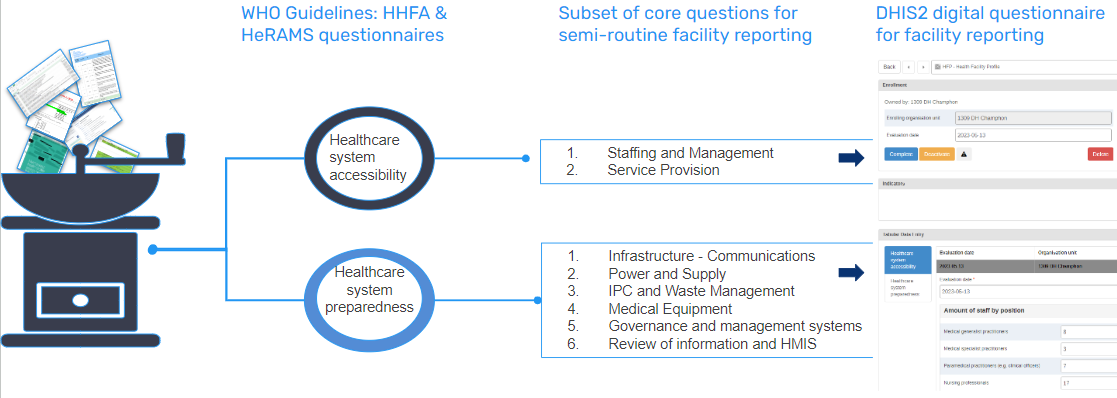
Many elements of the questionnaire are aligned to subset of questions from the WHO’s Harmonized Health Facility Assessment (HHFA) to allow routine monitoring of core variables in between surveys; as well as providing an opportunity to digitize subsets of the HHFP data in the national DHIS2 as baseline data and a source for triangulation & analysis. For example, a country that conducted an HHFA in 2020 may import the subset for key variables as baseline data; then use the rHFP reporting module to update these and other data variables in 2021. The source of variables in the questionnaire is provided in the metadata code field. Cross-checks have also been made to identify synergy with tools such as HeRAMS (for health emergencies), Global Fund reporting on health systems strengthening, and other commonly requested data such as number of mobile devices available for use at the facility.
Note
The routine Health Facility profiles (rHFP) module does not replace standardized, comprehensive health facility surveys such as the WHO’s HHFA. Rather, the rHFP module is intended to complement such surveys and approaches, enabling countries to capture and analyze data more routinely alongside their health facility service data and other routine data captured in the HMIS. The approach provides a low-cost method for routine updates and ad hoc spot checks of key facility information needed by planners and policy makers on an annual or six-monthly basis. This recommended questionnaire included in this module is not designed to address the measurement of quality of services, or to collect observational/qualitative information. Note that the rHFP is not intended to replace formal processes and procedures for updating the Master Facility List, which may require specialized skills in recording geographic coordinates and authorities for confirming operational status of facilities. However, some information gathered through the rHFP tool may be useful to feed into MFL update processes.
Předpokládaní uživatelé
- Program managers & staff (national & sub-national): data users who are responsible for routine analysis of data, using data to improve operations and programme strategies, and providing data-driven feedback to programme staff, including implementing partners, facilities, and other service delivery points
- Programme data managers: users who are responsible for overseeing data collection, management, data quality, analysis and reporting functions
- System admins/HMIS focal points: MOH staff and/or core DHIS2 team responsible for maintaining and improving data systems for health programmes, integrating data streams into national platforms, providing technical support for system design, adaptation and end user support; and maintaining the DHIS2 system over time
- Health facility managers & district health officers: data collection and analysis for assessment of equipment/service availability, planning and preparedness for both routine or emergency situations
Design structure
The DHIS2 Health Facility Profile configuration is structured in two (2) major components:
- Dashboard & indicators: Example of dashboard for analysis of routine Health Facility Attributes popualted by Program Indicators
- Tracker program: DHIS2 tracker program has been configured for individual-level (health facility) data collection. The tracker program can be used with the DHIS2 web or Androids clients
Dashbaord & Analytics
Dashboard
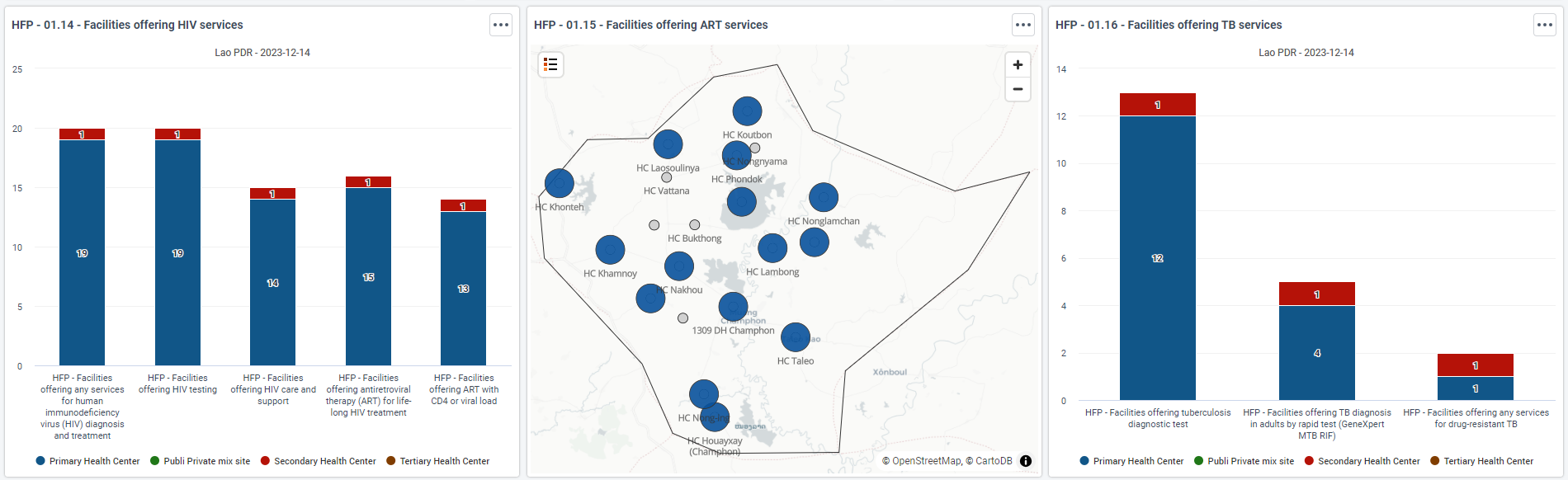
The dashboard included in the toolkit serve as an example of integrated analysis of Health Facility Attributes routinely reported within a HMIS for a targeted district

Analytika
In the context of a cohesive and integrated routine Health Management Information System (rHMIS) at the national level, the Analytics component plays a pivotal role in unlocking the full potential of health facility attributes data. The integration of health facility profiles into the HMIS provides a rich source of information that, when triangulated with other datasets, offers a holistic understanding of the healthcare landscape.
Implementations may vary based on design, relevance, scale, and content, but certain cross-cutting principles and suggestions are applicable across diverse local implementations. The integration of health facility attributes data within the HMIS sets the stage for comprehensive analytics, enabling data triangulation with various other datasets. This approach fosters a more nuanced analysis of healthcare service delivery by triangulating information on service availability, staff distribution, and material resources.
Data triangulation
One of the key advantages of data triangulation lies in its ability to provide a multidimensional perspective on healthcare facility operations. By correlating information on service availability with staff distribution, health planners can identify areas of potential service gaps or areas where workforce optimization is needed. Similarly, triangulating material availability data with service and staff information facilitates a deeper understanding of resource allocation and utilization patterns.
In the perspective of an integrated rHMIS at the national level, data triangulation becomes a powerful tool for evidence-based decision-making. This approach enables health authorities to make informed decisions regarding resource allocation, infrastructure development, and service optimization. By leveraging the interconnectedness of health facility attributes data with other datasets, the analytics component not only enhances the granularity of insights but also contributes to a more responsive and efficient healthcare system.
Ultimately, the integration of health facility attributes data into the HMIS, coupled with robust analytics and data triangulation practices, empowers health planners to move beyond isolated metrics and gain a comprehensive understanding of the healthcare landscape. This section explores the significance of data triangulation in the context of the Health Facility Profile toolkit within DHIS2, emphasizing its role in promoting a data-driven and integrated approach to healthcare decision-making.
It is of great importance to underline that the triangulation exercise is not able to provide an inferential conclusion, but, rather, to trigger questions and further research to deepen the type of results one can observe from the mapping - are the key populations at risk (eg children under 5) able to reach a health facility within the national coverage buffer radius? Are the highest deaths linked to a higher concentration of population, to the lack of health staff, or any other geographical factor? It is possible to use two layers to investigate possible environmental and geographical factors in the equation:
- Landcover layer: the layer will provide information on the biophysical cover of the area (water, urban areas, forests, etc). The presence of lakes or any other water basin could be important as a factor for malaria.
- Temperature layer: temperature, together with any entomological and vector control data could feed into the triangulation exercise to map the presence of vectors in the area.
- Elevation layer: like the temperature layer, elevation plays an important role in the vector distribution as well as in the ability to reach the available health facilities. The layer could potentially highlight that although the facilities are covering certain areas within the buffer, the radius only considers the crow’s flight distance between the area and the health center. The presence of mountainous areas could play a role in the health seeking patterns of the population, impacting in turn the health outcomes values.
Health staff density VS population map
- Population layer (either total population or disaggregated by sex and age if and when relevant). Ensure that a Google Earth account is available to import the population data into the instance from the Google Earth database. OR
- Building footprints layer: the layer allows users to see what portion of a surface is covered by all the footprints of buildings belonging to the population under analysis. If available, the layer will highlight easily the most remote buildings vs the facilities
- Facility layer: Map the geographic location of the facilities and add a radius to highlight the catchment area of the facility. The system defaults the radius to 5000 m, though the implementation should refer to the national policy of standard measurement radio for population served. This approach is particularly recommended where the DHIS2 version is below 2.39 and where there is no capacity to apply the catchment area and distances as available in the CrossCut application.
- Thematic layer: choropleth when proportions are under analysis and bubbles when numbers are. The layer will use the indicators of density of health staff (GPs, nurses, midwives, laboratory technicians, etc).
The buffer highlighting the radius of service of the health facilities will highlight any uncovered population, particularly if of high density. The density of health staff could be easily colour coded via a legend as per national policy in order to underline the appropriateness of the number of available staff (e.g. less than 25 nurses per 100,000 population can be set as red, and more than 25 per 100,000 population as green - threshold based on WHO NLiS)

Health outcomes/volume of service VS population map
- Population layer (either total population or disaggregated by sex and age if and when relevant). Ensure that a Google Earth account is available to import the population data into the instance from the Google Earth database.
- Facility layer: Map the geographic location of the facilities and add a radius to highlight the catchment area of the facility. The system defaults the radius to 5000 m, though the implementation should refer to the national policy of standard measurement radio for population served. This approach is particularly recommended where the DHIS2 version is below 2.39 and where there is no capacity to apply the catchment area and distances as available in the CrossCut application.
- Thematic layer: choropleth when proportions are under analysis and bubbles when numbers are. Depending on the available data present in the local HMIS information such as malaria deaths, volume of OPD visits, etc can be plotted.
Similarly to the previous map, the population layer will provide the areas of highest concentration, while the facility layer will present the location of the health facilities providing the relevant services and the buffer of coverage as per national policy. Taking into account the example of malaria deaths, the triangulation will show the inhabited areas, the coverage of the facilities providing malaria services, and the health outcome data will plot the areas by number of deaths. In particular, if the national policy states a specific goal to be achieved on the specific indicator, the threshold could be further mapped using a legend separating the facilities achieving the goal and those that are not.
Trasovač
Tracker Program Structure
The tracker program structure is as follows:
| Stage | Popis |
|---|---|
| Zápis | The enrollment stage collects the basic institutional data about an Health Facility as Facility code, Adress, Facility location, Type of Facility and Managing authority. The stage is non-repeatable. |
| Healthcare system accessibility | This stage contains the information related to service provision, staffing and management. The stage is repeatable. |
| Healthcare system preparedness | This stage contains the information related to infrastructure and communications, power and supply, IPC and waste managemn, Medical equipment availability, governance and management systems, review of information and HMIS. The stage is repeatable |
TrackedEntityType
The DHIS2 Health Facility Profile tracker program allows for the enrollment of a tracked entity type [TET] ‘Health Facility’.
Zápis
It is assumed that an Health Facility should be enrolled only once in the Health Facility Profile tracker program as it refers to a static structure.
The information reported on the enrollment stage could already ben present as Organisation Unit attributes or Organisation Unit group and therefore needs to be customized prior implemenation to avoid a duplication of information reported

Healthcare system accessibility (repeatable)
The data acquired at this stage are divided in seven (7) sections according to the type of information reported:
- Amount of staff by position

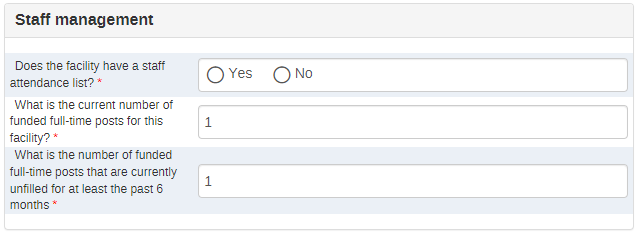
- Staff management
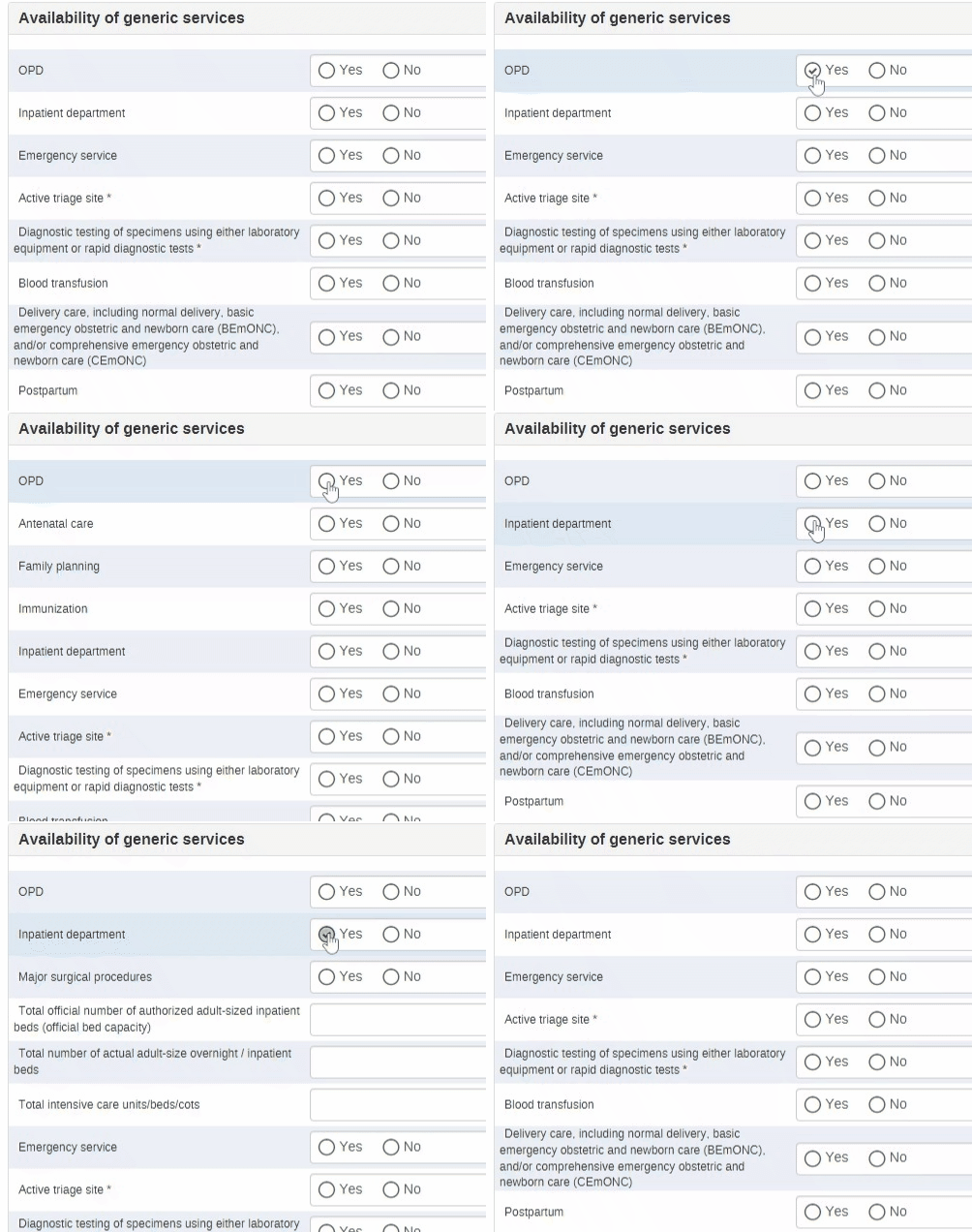
- Availability of generic services: some of the services are shown following spcific program logics
- Availability of specific services as HIV/TB/Malaria, NCDs and COVID-19: these services have been kept in separate sections as of particular interest for global reporting

- Community Health workers supported services

Healthcare system preparedness
The data acquired at this stage are divided in eight (8) sections according to the type of information reported:
- Infrastructure - communications

- Power and cold-chain

- IPC and sterilization

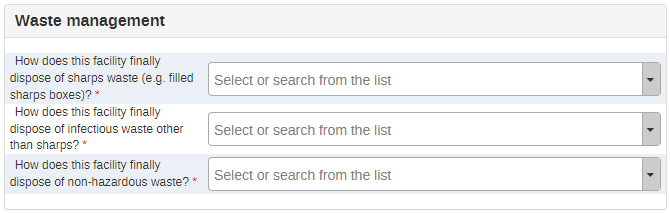
- Waste management
- Medical equipment

- Governance & management and Health Information System

Tracker Data Elements
All data elements configured for the Tracker domain are also included in the Data Element Groups:
- HFP - Healthcare system accessibility [TOsFeelSRtJ]
- HFP - Healthcare system preparedness [GUQpQH7YKuS]
This serves as a de facto DHIS2 data dictionary for the Health Facility Profile tracker use case. It allows for the data elements to be exported from DHIS2 and used independently of the Tracker program configuration, for example in the case that an implementation redesigns their Tracker from scratch for local workflows and still wants to maintain allignement with the HHFA mapping.
Cloned data elements for multiple option selection
Within the repeatable program stages for Healthcare system accessibility and Healthcare system preparedness, there are a number of data elements that are cloned to allow the selection of multiple options for a given concept, sharing the same option set. This design is implemented as follows:
- Cloning of data elements eligible for multi-option choice
- The number of clone of the data element must be the same as the number of options present in the related option set
- Each cloned data element has its own UID, name and code
- Pravidla programu
- Hide the consequent Data Elements if the previous have not been selected
- Show error in case the same Option has been selected more than once in the same group of Data Elements
For example, to capture multiple services provided by Community Health Workers, there are a series of data elements that are cloned to represent each discrete diagnosis:
- HFP - Systems for linking with CHW for service 1 [dyj087dkBml]
- HFP - Systems for linking with CHW for service 2 [pcFgoO9E45l]
- HFP - Systems for linking with CHW for service 3 [grdsdCsfNuq]
- HFP - Systems for linking with CHW for service 4 [eSX1gtZPMP0]
Skupiny uživatelů
| Uživatelská skupina | Metadata | Data |
|---|---|---|
| HFP - Admin | Může upravovat a prohlížet | Žádný přístup |
| HFP - Access | Lze pouze prohlížet | Lze pouze prohlížet |
| HFP - Data capture | Lze pouze prohlížet | Může zachytit a zobrazit |
Implementation Considerations & Local Adaptation
This chapter describes some of the possibilities for adapting the configuration for local context and needs, as well as implementation considerations that are relevant for the Health Facility Profile use case.
HMIS integration
The significance of integrating the Health Facility Profile component into the routine Health Management Information System (HMIS) lies in the consolidation of crucial health facility attributes in one centralized platform. This integration eliminates the pitfalls of scattered information across disparate systems, ensuring a unified repository for comprehensive data on service availability, infrastructure readiness, and staff distribution.
By anchoring health facility profiles within the routine HMIS, the consolidation enhances data triangulation capabilities. The amalgamation of health facility attributes with other health information datasets provides a more nuanced understanding of healthcare service delivery. This triangulation allows for correlations between service availability, staff distribution, and material resources, unlocking deeper insights that are vital for strategic planning and resource optimization.
Moreover, the integration of the Health Facility Profile in the HMIS dramatically increases information accessibility for decision-makers. Having all pertinent data in one place streamlines the decision-making process, offering a holistic view of health facility operations. This centralized accessibility empowers decision-makers with the comprehensive insights needed to make informed choices, enhancing the overall effectiveness and responsiveness of healthcare management. In essence, the integration of the Health Facility Profile in the routine HMIS not only simplifies data management but also amplifies the strategic impact of health information for more effective and informed decision-making.
Importing baseline data from other sources
HHFA
With over 80% alignment between the Health Facility Profile (HFP) and Harmonized Health Facility Assessment (HHFA) questionnaires, countries can expedite data analysis in DHIS2. Leveraging this synergy, importing baseline data from the last HHFA enhances the richness of the HFP dataset. By assigning the date of the last HHFA as the Event date in DHIS2, this seamless integration ensures accurate temporal mapping. This strategic approach not only accelerates the value of data analysis but also streamlines the utilization of existing HHFA data within the HFP, optimizing the efficiency and coherence of health information management.
The DHIS2 code field indicates the mapping to the relevant variable from the WHO HHFA tool as follows: HFP_HHFA_1534_CERICAL_CANCER_TRAINING: HHFA code → 1534
Data collection VS system maturity
The method of electronic reporting depends largely on the availability of internet/infrastructure and use of DHIS2 at facility level. Implementations may use a hybrid approach depending on readiness to report at the facility level. These are options we have considered most practical for our current understanding of the use case:
Option 1: Facility For facilities that are already equipped for electronic routine reporting in DHIS2, they can access the new rHFP questionnaire through DHIS2 and enter self-reported data directly. Some training may be required for facility users to complete the Tracker Program questionnaire and comply with frequency and timing of the reporting.
Option 2: District reporting For facilities that don’t have internet connectivity or access to DHIS2, it is recommended that district health officers consider conducting the questionnaire at the facility using an offline mobile device. Where district health offices have tablets, these can be reused for offline data collection during visits to the facility with the data collection tool in the DHIS2 Android Capture app. This app allows syncing with the DHIS2 instance as soon as internet connectivity is restored.
Reference
WHO. Harmonized Health Facility Assessment (HHFA) https://www.who.int/data/data-collection-tools/harmonized-health-facility-assessment/introduction
WHO. Density of nurses and midwives (NLIS) https://www.who.int/data/nutrition/nlis/info/density-of-nurses-and-midwives