Larviciding
Larviciding is a malaria vector control intervention that consists in the regular application of biological or chemical insecticides to water bodies to kill larvae and pupae present in them. Killing larvae or pupae will reduce the number of adult mosquitoes that there will be in the environment transmitting malaria to humans.
WHO conditionally recommends the regular application of biological or chemical insecticides to water bodies (larviciding) for the prevention and control of malaria as a supplementary intervention in areas where optimal coverage with ITNs or IRS has been achieved, where aquatic habitats are few, fixed and findable, and where its application is both feasible and cost-effective.
Vector Control - Larviciding
This tracker program allows the users to collect data from and monitor larviciding campaigns, namely to collect data on larviciding application to each larval habitat and to visit the larval habitats afterwards to check on the presence/absence of larvae or pupae of different vector species.
| Fáze | Popis |
|---|---|
| Zápis | Initial step of the registration of the activity. The tracked entity is the larval habitat. |
| Breeding treatment | This stage collects information on the habitat’s treatment with larvicides. It contains two sections, one on the characteristics of the habitat at the time of the visit and one on further information on the habitat in case the breeding site has been treated. Breeding site monitoring Breeding treatment |
| Breeding site monitoring | This stage collects information the habitat’s monitoring visits post-treatment, including whether larvae or different mosquito species are absent or present, the stage of the present larvae and the number of larvae or pupae found of each mosquito species. |
Data Elements and Tracked Entity Attributes
The full list of data elements and TEAs is available in the metadata reference file.
The DEs in this program are not shared with any other program in the E&VC package.
Tracker Details
Enrollment and Profile
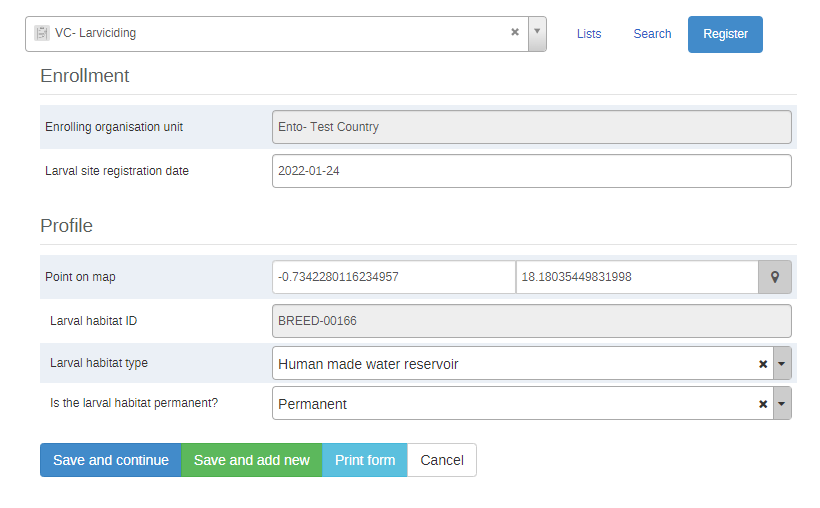
The enrollment of the larval habitat (or breeding site) requires the reporting of the basic information about the habitat. The coordinates can be either entered manually or added automatically upon the pinning of the location on the map that automatically opens when clicking on the location icon on the right of the Point of map variable. The breeding site ID has been set to automatically assign an identifying code to the site being reported. The automatic code can either be modified according to national policies or be set to be manually entered.
The types of larval habitat can be adapted to the national context. The permanence of the larval habitat should be recorded, as it is important to plan larviciding campaigns. Permanent refers to larval habitats present all year round. Temporary refers to larval habitats present on a seasonal basis.
Breeding Site Monitoring Stage
After larviciding is conducted, teams are sent to the field to monitor larvicide application, as a quality control measure. This section serves to collect the results of the monitoring visits. As a result of such activity,countries will have enough information to estimate larval densities for different breeding sites and use these data to prioritize larval habitats for larviciding.
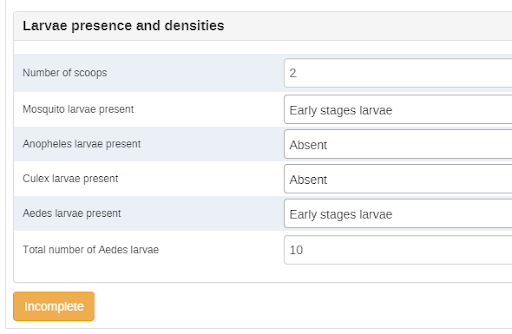
The form first asks the user to enter the number of scoops and what type of mosquito larvae are present. If the user indicates that larvae or pupae of any species is absent, then the DE to enter the number of larvae disappears.
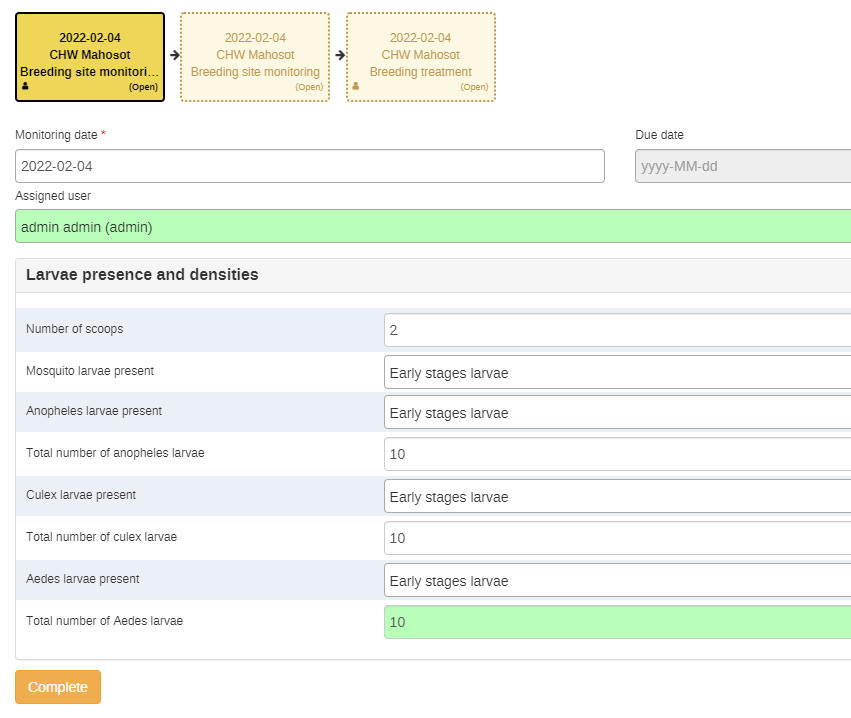
In every spoon of larvae there will likely be larvae at different stages. The user should indicate the oldest larvae stage identified among the collected larvae - for example: in 3 scoops there are 10 larvae, among which there are 2nd instar and 3rd instar larvae. The user in this case should report the latest stage, the third instar, independently on the amount of other stages present. The instar-stage association should follow: early stages = to first and second larvae instars, while later stages = third and fourth instars.
Upon implementation, should countries need to have different option sets such as : instar 1, instar 2, instar 3, instar 4 and pupae, they can change the assigned option set (although difficult to discern between instar 1 and 2 at first sight). Countries could also potentially want to add other mosquito genus when they start doing integrated vector surveillance (= surveillance of vectors of different diseases all at once).
If no Spp-specific larvae are identified, the DE on the number of larvae will not appear.
Breeding Treatment Stage
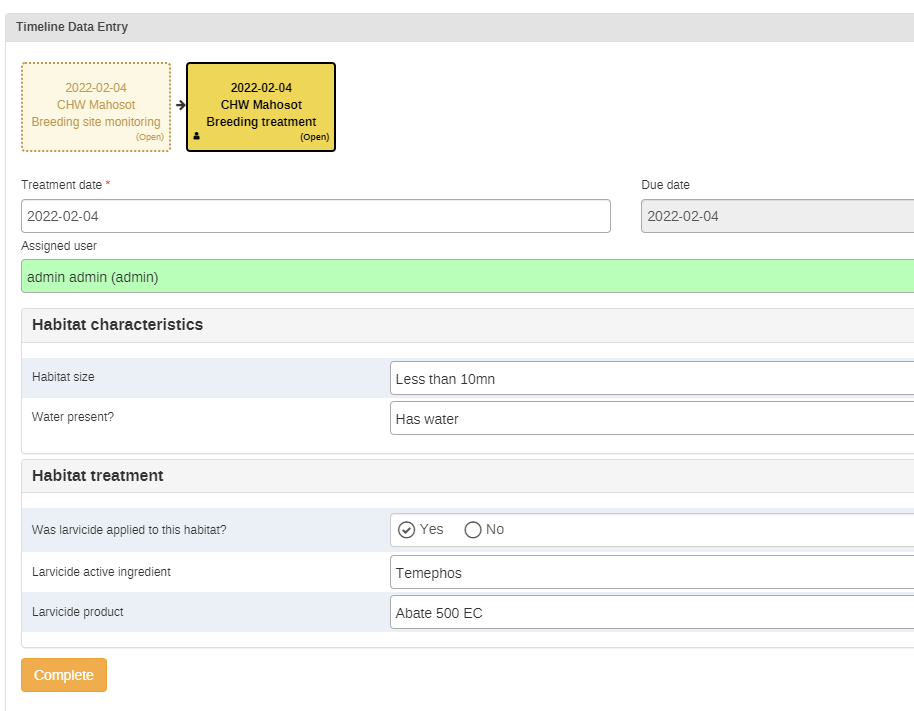
Upon the completion of the enrollment, the user has to fill in the breeding treatment stage. The stage collects the data on the habitat characteristics (size and presence of water) and on the larvicide applied. The larvicide active ingredient and the Larvicide product data elements appear only if YES is selected in the previous step - Was larvicide applied to this habitat? The option lists for Larviciding active ingredient and Larvicide product reflect the WHO prequalified products for larviciding. The lists can be expanded or reduced according to product availability and local context.
Pravidla programu
The tracker is equipped with a number of program rules that help the logical flow of the metadata. The full list of PRs is available in the metadata reference file.
Analytika
Programové Indikátory
There are a number of predefined PIs already configured in the metadata reference file. The list of PIs can be expanded depending on local analytic needs.