Mpox Surveillance Toolkit
Version 0.0.1
Úvod
The global mpox outbreak, which began in May 2022, has required a coordinated and robust response focused on surveillance, case investigation, and contact tracing. To support these efforts, the World Health Organization (WHO) has issued interim guidance aimed at controlling and ultimately eliminating human-to-human transmission of mpox. This guidance is especially crucial given the diverse epidemiological patterns observed globally, including the emergence of mpox in regions outside of Africa, where the disease had historically been endemic.
Přehled
This document outlines the design framework for integrating mpox surveillance into routine health information systems (HMIS), including data reporting and contact tracing. Depending on the local context, data can be collected through paper-based methods or via electronic individual-level systems, such as DHIS2 Tracker or other compatible tools. The mpox surveillance framework aims to capture both case-based and aggregate reporting, ensuring consistency with the WHO 2024 guidance on data generation and use in public health surveillance. Updates to data entry forms, definitions, and indicators reflect current practices in contact tracing, laboratory testing, and clinical case management. This approach ensures that mpox data is integrated seamlessly into broader public health efforts, facilitating real-time monitoring and timely interventions.
Structure and Design
The Toolkit for Mpox Surveillance comprises:
- An aggregate weekly dataset for IDS surveillance
- A tracker for the Case Reporting Form (CRF)
- A Tracker for the Case Investigation Form (CIF)
Note: The metadata packages are built as stand-alone modules. The concept of maintaining this as a stand-alone module is intended to streamline its adoption, recognizing that full integration of the standard toolkits may have not been fully realized in many implementations. By offering a more focused and simplified module, it becomes easier for stakeholders to adopt without the need for complex systems overhaul or integration. This modular approach allows for gradual uptake while ensuring that essential elements of the toolkit are implemented effectively, even in environments where the broader IDS and CBS systems may not yet be fully established.
Aggregate IDS Mpox Design
The toolkit provides essential information required for reporting within an IDS system. The packaged dataset follows a flat structure, divided into two key sections: one for surveillance and one for laboratory results. The age disaggregation is set at 0-4 and 5+ years to align with the global IDS standard, but implementers have the flexibility to modify these categories to better suit local designs and requirements.
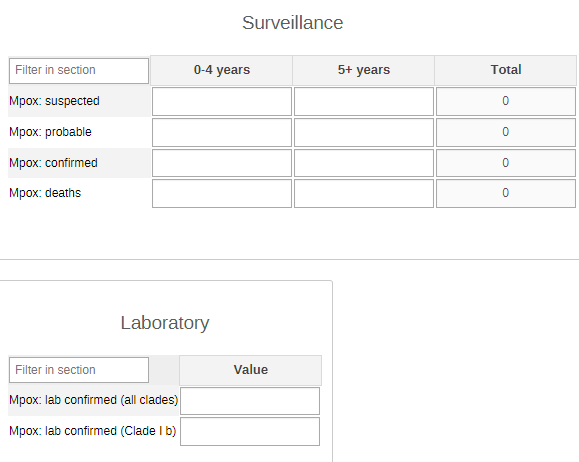
In the mpox demo, the dataset is integrated into the existing IDS global toolkit. Mpox-related metadata can be found in the custom dataset titled “IDS - Report: Suspected, Confirmed, Death”, “IDS - Report: Suspected, Death” and within the “IDS - Aggregate Lab Weekly Report.”
Note: Input is still pending from the different working groups regarding the inclusion of discarded cases, reinfections, and the distinction between lab-confirmed and clinically confirmed cases in the metadata package. Further clarification is also pending on whether specific variables should be added to capture data on exposed healthcare workers and travel-related or imported cases.
Mpox Case-based Surveillance
Case Reporting Form (CRF)
The CRF is an essential tool for standardising data collection and reporting for surveillance purposes. The CRF is typically a standardised form used to gather the essential details required to notify public health authorities of a case. It ensures that each case is consistently reported, often as part of national or international reporting requirements.
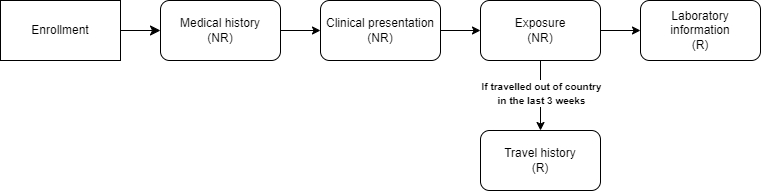
The Mpox CRF self-standing design includes the enrollment and six stages (three non-repeatable - NR-, and two repeatable -R-)
| Stage | Information collected |
|---|---|
| Zápis | Collects the basic demographic information of the case, including classification, sexual behaviour, profession, and IDP/refugee status. Malnutrition-related information can only be filled if the patient is less than 5 y/o. The Tracked Entity Type for the Mpox CRF program is ‘Person’. |
| Medical history | Collects information on immunosuppression and HIV status, reinfection and Mpox vaccination. The stage is non-repeatable |
| Clinical presentation | Collects information on symptoms, hospitalisation, complications and outcome. The stage is non-repeatable |
| Exposure | Collects information related to the suspected, probable or confirmed mpox case the patient has been exposed to with details on the setting, travel history, any animal contact with details on the type and the animal group and the most likely mode of transmission. The stage is non-repeatable |
| Travel history | Collects information related to the country/region visited of each one of the countries that the case has travelled to in the last 21 days. This stage can be filled only if it has been indicated that the patient has travelled in the “Exposure” stage. The stage is repeatable |
| Laboratory information | Collects information on the date of testing and sample collection, specimen type, laboratory method and genomic characterization for each one of the specimens sampled. The stage is repeatable |
The design of the CRF follows the one published by the WHO on 09/09/2024 Mpox Case Investigation Form (CIF) and minimum dataset Case Reporting Form (CRF).
The information collected on the CRF doesn’t need to track the TEI (Tracked Entity Instance) during time/services therefore the structure of the program can be switched from tracker to event according to the implementation. Having the structure of the CRF self-standing module as tracker-based can facilitate its integration into existing integrated surveillance systems and avoid data manipulation in case new components will need to be added in the future.
A set of Program Indicators have been developed to populate the aggregate data set “Mpox surveillance” present in the IDS Mpox module via the Data Exchange app (payload included in the json)
Note: Program indicators use custom period boundaries to report cases based on their diagnosis date instead of the notification one (in this case used as Enrollment date)
Case Investigation Form (CIF)
While the CRF contains high-level information, ensuring cases are reported promptly to the health authorities, the CIF is used for a more detailed investigation of a suspected, confirmed or probable case of mpox to inform response efforts. It helps trace contacts, assess transmission routes, and identify potential sources of infection.
The Mpox CIF self-standing design includes the enrollment and 14 stages ( 6 non-repeatable -NR-, and 8 repeatable -R-)

| Stage | Popis |
|---|---|
| Zápis | Collects the basic demographic information of the case, case identification, data collector details, classification and status and the healthcare/treating Physician’s details. Malnutrition-related information can only be filled if the patient is less than 5 y/o. The Tracked Entity Type for the Mpox CIF program is ‘Person’. |
| Clinical and vaccination information | Collects information on the STIs, Immunosuppression and HIV status, pre or post-exposure vaccination, signs and symptoms and complications. The stage is non-repeatable |
| Exposure to probable or confirmed case | Collects information on the contacts with other suspected, probable or confirmed mpox cases, travels outside the country and contact with animals. The stage is non-repeatable |
| Exposure events | Collects information related to the suspected, probable or confirmed mpox case the patient has been exposed to with details on the relationship, type of contact, details of exposure, place of exposure, presence of any symptoms and relative household and healthcare setting details in case they have been selected as the type of contact and/or details of the exposure. The stage is repeatable |
| Exposure in household setting | Collects information on the location of the household and its size. This stage can be filled only if the household has been selected as type of exposure and/or details of exposure in the “Exposure events” stage. The stage is non-repeatable |
| Occupational exposure in healthcare settings | Collects information on the location type of health work, place of work and details of the exposure. This stage can be filled only if the healthcare setting has been selected as the type of exposure and/or details of exposure in the “Exposure events” stage. The stage is non-repeatable |
| Sexual activity | Collects information on the number of sexual partners in the past 3 months and weeks and their gender. This stage can be filled only if neither household or healthcare setting has been selected as the type of exposure and/or details of exposure in the “Exposure events” stage. The stage is non-repeatable |
| Sexual partners | Collects information related to the type of sex practised, protected sex, type of sex partner and the encounter method for each one of the sexual partners. This stage can be filled only if the case reported one or more sexual partners in the last 3 weeks in the “Sexual activity” stage. The stage is repeatable |
| Travel history | Collects information related to the country/region visited and date of entry/departure of each one of the countries that the case has travelled to in the last 21 days. This stage can be filled only if it has been indicated that the patient has travelled in the “Exposure to probable or confirmed case” stage. The stage is repeatable |
| Animal exposure | Collects information on the type, place, time and type of contact and status of each one of the animals that has entered in contact with the case in the last 3 weeks. This stage can be filled only if it has been indicated that the patient has had contact with animals in the “Exposure to probable or confirmed case” stage. The stage is repeatable |
| Most likely mode of transmission | Collects information on the most likely mode of transmission. The stage is non-repeatable |
| Disease severity and outcome | Collects information on the hospitalisation, access to ICU and the final outcome at the moment of the CIF completion. The stage is non-repeatable |
| Diagnostic /Pathogen testing | Collects information on the Laboratory ID, specimen type, test performed, result and genomic characterization for each one of the specimens sampled. The stage is repeatable |
| Forward tracing | Collects information on the history and location of the contact. The stage is non-repeatable |
| Contact details | Collects basic demographic information of the contact. This stage can be filled only if it has been indicated that the patient had any contact with, or stayed in the same household as, one or more persons in the period between onset of symptoms or diagnosis and recovery in the “Forward tracing” stage. The stage is repeatable |
The design of the CIF follows the one published by the WHO on the 09/09/2024 Mpox Case Investigation Form (CIF) and minimum dataset Case Reporting Form (CRF).
A set of Program Indicators have been developed to populate the aggregate data set “Mpox surveillance” present in the IDS Mpox module via the Data Exchange app (payload included in the json).
Note: Program indicators use custom period boundaries to report cases based on their diagnosis date instead of the notification date (in this case used as Enrollment date).
Use of CRF vs CIF
To enhance the possibility of scaling up the data collection tools and easily incorporate CIF metadata in the CRF module according to the implementation requirements, most of the metadata (Tracked Entity Attributes and Data Elements) in the CRF self-standing module is shared with the CIF program: - 76/110 (69%) CRF metadata has a perfect match in the CIF (same UID) - 32/110 (29%) CRF metadata has a partial match in the CIF (different UID). This partial match can be resumed in two categories: - Same element but different value type / Option set assigned (e.g. symptoms) - Multioption required in one module and not in another (e.g.Hospitalisation, Animal type/contact group) - 2/110 (2%) CRF metadata has no match in the CIF
Here you can find the mapping of metadata between the two programs.
The modular composition of both CRF and CIF enhance the possibility of integrating or removal of specific stages/sections based on the implementation needs.
Analytics and Data Visualization
Indikátory
The current aggregate indicators configured for Mpox, specifically IDS - Mpox case fatality rate (%) and IDS - Mpox confirmed cases (%) use data elements in numerator and denominator that are disaggregated by age and sex. Adding a disaggregation dimension to these indicators will not produce the intended results. Both numerator and denominator will be disaggregated by age group, which will lead to the percentages relative to disaggregated groups and not a proportion of the total.
If there is a need to disaggregate the percentage by specific age/sex group, a separate indicator with that particular group in the numerator has to be created. The denominator should represent the total. This value can either be aggregated using a predictor or extracted from the corresponding tracker (if used).
If age/sex disaggregations are not required for the indicator, this note can be disregarded.
Ovládací panel
The Mpox metadata is displayed in a single dashboard titled “IDS-Mpox”. This dashboard is dedicated to mpox-related metadata; however, depending on local implementation needs, users have the flexibility to either integrate these visualizations into existing surveillance dashboards or maintain them as a standalone mpox-specific dashboard.

The IDS-Mpox dashboard is designed to be straightforward, presenting core indicators as outlined in the 2024 interim guidance. It includes:
- A general epidemiological overview: Featuring a cascade and at-a-glance summary of the reporting period (set to the previous month by default but adjustable to fit local needs).
- Epidemic curve and timeline choropleth map: These visualizations offer an evolutionary view of the outbreak, helping to monitor the progression over time.
- Detailed case data: Information on suspected cases, testing rates, and laboratory results.
- Mortality tracking: Death curve and split-view map providing insights into deaths and the case fatality rate, allowing for a temporal overview of these critical metrics.
This modular design ensures that the dashboard adapts to varying epidemiological needs and supports comprehensive monitoring of the outbreak’s evolution, aiding local health authorities in decision-making and response.
Special Considerations
Triangulation with Animal Surveillance
Triangulating mpox surveillance with animal surveillance is a critical strategy in understanding and controlling the spread of the virus. Given the zoonotic source of the disease, with potential for animal-to-human transmission, particularly in regions where the virus is endemic in wildlife, integrating human and animal surveillance efforts is essential. This approach allows for the identification of potential animal reservoirs, the detection of transmission pathways, and the prevention of new spillover events. By combining data from human case investigations, contact tracing, and animal surveillance, public health authorities can gain a comprehensive view of the transmission dynamics.
The DHIS2 Animal Health toolkit plays a vital role in this integration, offering a platform for systematic surveillance of animal populations, particularly for zoonotic diseases. This toolkit, developed in collaboration with organizations like the CDC and FAO, can function as a standalone system or be integrated with human health surveillance data to support a One Health approach. This cross-sectoral collaboration enables real-time reporting of unusual animal health events, which can then trigger timely investigations. By using DHIS2 for both human and animal surveillance, authorities can effectively manage zoonotic risks, ensuring the health of people, animals, and ecosystems is addressed in a unified manner.
Triangulation with Mpox Immunisation Activities
Integrating mpox surveillance with immunization data is crucial for controlling outbreaks and preventing future cases through targeted vaccination efforts. By combining surveillance data with immunization records, public health authorities can gain valuable insights into population immunity and identify gaps in vaccine coverage. This integration allows for more effective monitoring, enabling authorities to track not only the spread of the virus but also the success of vaccination campaigns, ensuring that high-risk groups are adequately protected and transmission is minimized. This data triangulation strengthens both surveillance and immunization strategies, ensuring that resources are used efficiently and vulnerable populations receive the necessary preventive care. DHIS2’s Expanded Program on Immunization (EPI) and Electronic Immunization Registry (EIR) toolkits are well-suited to support this triangulation. The EPI toolkit manages routine immunization programs, while the EIR toolkit provides comprehensive tools for tracking individual vaccination records. In addition to routine immunization data, the toolkits also support Supplementary Immunization Activities (SIAs), enabling countries to organize targeted vaccination drives and monitor their impact alongside routine efforts.
The DHIS2 demo environment includes examples of triangulating routine data with SIAs, offering valuable insights for mpox vaccination strategies. Furthermore, triangulation dashboards in DHIS2 showcase key indicators and visualizations that combine immunization and surveillance data. These dashboards can be customized and adopted to monitor and optimize vaccination efforts against mpox, providing real-time insights into coverage and performance gaps, while improving the overall response to the outbreak.