Common Metadata Library
Úvod
This document describes a metadata package that provides a baseline of core DHIS2 metadata for use across multiple programs or datasets. The metadata included are not programme/use case specific, but are generally expected to be shared across tracker programs as part of a harmonized HMIS.
Jednou z klíčových výhod DHIS2 je, že jej lze použít pro více zdravotních programů v rámci jediné harmonizované instance. Existuje několik praktických důvodů, proč sdílet metadata mezi trasovacími programy:
- Pro omezení duplicitního zadávání dat a zlepšení datových toků, např. kde lze údaje o osobě zaznamenané v jednom programu přenést do jiného programu;
- To improve analytic capabilities across programs by re-using common metadata and its associated codes for core attributes like Sex;
- Usnadnit údržbu metadat v systému
Balíčky metadat DHIS2 jsou navrženy a harmonizovány způsobem, který umožňuje importovat více balíčků do stejné instance DHIS2. To lze provést za účelem propojení jednotlivých zápisů do různých programů nebo vytvoření synergií napříč toky podávání zpráv pro různé oblasti zdraví. Pacient může být například zařazen do programů sledování případů HIV i TBC, ale pohlaví pacienta je zaznamenáno pouze jednou v době první registrace. K tomu potřebují programy sdílet stejná metadata pro atribut trasované entity (Pohlaví) plus související sadu možností a možnosti (Muž, Žena a Neznámý).
Importing those common metadata together as a baseline package ensures that the Unique IDs, names, and codes for objects (e.g. tracked entity attributes, option sets, options, and data elements). In addition, if a custom program is developed within the same instance, it could re-use those metadata from the baseline package, thereby bootstrapping configuration of the new program, preventing namespace clashes and other complications during metadata import/export, and facilitating data exchange across platforms. This becomes particularly important when aligning tracker implementations that may exist across multiple instances into a shared, harmonized environment.
Přehled návrhu systému
Společná metadata sledování jsou zpřístupněna jako instalovatelné soubory metadat, které lze importovat do nové nebo existující instance DHIS2. Tyto instalovatelné soubory obsahují metadata, která jsou v souladu s několika běžnými případy použití pro DHIS2 Tracker:
Core Case Profile
The core case profile is a small collection of metadata objects in the tracker domain that represent identifiers and common data variables typically used across case-based registries. These metadata are re-used across all WHO case-based surveillance tracker packages (e.g. HIV, Malaria, TB, VPD, and COVID-19 case-based surveillance). The Core Case Profile was developed through an internal WHO harmonization process for identifying and harmonizing naming conventions for shared data variables across person-centered monitoring and case-based surveillance programs. There are many practical benefits of harmonizing these metadata in a DHIS2 instance, such as enabling the registration of a TEI 'person' in one program and making their personal details available for searching to enroll in another program (such as enrolling an HIV case into the TB program).
The core case profile includes the following objects:
- Tracked Entity Type (Person)
- Tracked Entity Attributes (e.g. given name, family name, date of birth)
- Options (e.g. male, female)
- Option Sets (e.g. sex)
Common Tracker Metadata
This library contains all objects from the core case profile above, plus other common metadata in the tracker domain such as data elements, option sets, and options. This library is not exhaustive, but contains metadata concepts that are included in official DHIS2 tracker packages, and are generic enough that they could be conceivably shared across programs (e.g. option sets for a list of countries or a data element for ‘date of death’). The library is intended to provide a selection of common metadata that implementers can take at their discretion in the development of tracker programs. This library will be more frequently updated and expanded on a semi-annual basis as metadata packages are developed and deployed.
All metadata in the Common Tracker Metadata Library comprise metadata groups containing the prefix GEN (for General). The prefix helps to signify to the implementer or system admin that the metadata object is being shared across programs, and impact across programs should be considered before making changes/adjustments to shared metadata.
- Typ trasované entity (osoba)
- Atributy trasované entity
- Option sets, including ISO 3166-1 alpha-2 country codes and country names
- Možnosti
- Datové prvky
- Vlastní atributy spojené s výše uvedeným (např. LOINC, Snomed, ICD-11)
- Attribute for aggregate data exchange
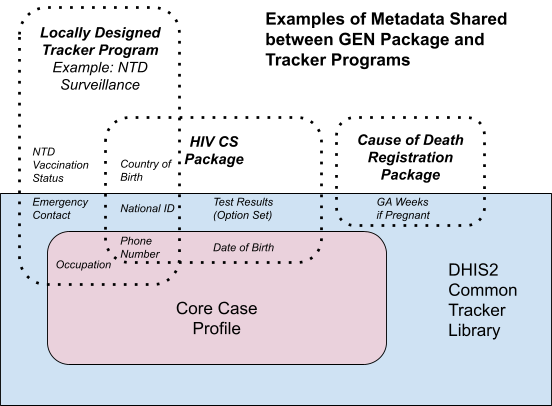
The diagram above illustrates a few points about the modular structure of the package. The Common Tracker Metadata library includes the entirety of the Core Case Profile, in addition to other metadata objects. A DHIS2 Metadata Package may utilize metadata found within the Core Case Profile, within the broader Common Tracker Library, or its own program-specific metadata (see HIV CS Package). Meanwhile, a custom, locally-designed tracker program may also utilize metadata found within the Core Case Profile, within the broader Common Tracker Library, or develop its own program-specific metadata.
Představte si scénář, kde je výše uvedený program NTD Surveillance vyvíjen nezávisle. Implementátoři se pak rozhodnou importovat balíček HIV CS do stejné instance DHIS2. Během importu metadat by docházelo k řadě konfliktů, protože objekty v každém programu mají stejný název a různé UID (telefonní číslo, národní ID a zemi narození). Pokud by byl profil Core Case Profile importován před konfigurací vlastního programu NTD, bylo by zapotřebí méně práce s konfigurací nových metadat a méně kolize při importu balíčku HIV CS.
Note that the GEN prefix is used internally within the package environment to signify that the metadata is shared across programs; however, the GEN prefix will not be visible to end users of your programs. These metadata come translated for different locales, and can be further translated to other local languages without interfering with the baseline UIDs, names, and codes.
Common Aggregate Metadata
The purpose of these metadata are to store the most commonly used population denominators.
This file includes 6 different indicator types
-
Pouze čitatel (číslo)
-
Per 10 000
-
Per 100 000
-
Na 1000
-
Procento
-
Rate (factor=1)
Total population and populations under 1 year, under 2 years, and under 5 years are included, as are the number of live births, and total number of expected pregnant women. Indicators included to process and display population data are "numerator only".
A variety of category options for common age and sex disaggregations of population are included. Before being used as dimensions of population data, these categories would have to be manually added to categories, and then those categories added to category combinations and fianlly to data elements.
Complete Common Metadata Library
This file includes ALL metadata from "Common Tracker Metadata" and "Common Aggregate Metadata" files.