Community Health Information System (CHIS) - System Design Document
Úvod
Standardizovaný a fungující komunitní zdravotnický informační systém (CHIS) je klíčový pro monitorování zdraví, potřeb a postupů na úrovni komunity. Balíček metadat komunitních zdravotních informačních systémů (CHIS) je navržen tak, aby usnadnil zachycení a analýzu základní sady ukazatelů pro komunitní zdravotnické služby. Balíček metadat CHIS doprovází Analýza a použití komunitních dat WHO: Pokyny pro monitorování komunitních zdravotních služeb. Pokyny reagují na rezoluci Světového zdravotnického shromáždění WHA72.3 z roku 2019, která požaduje a) sladění dat a digitálního úsilí s cílem optimalizovat programy komunitních zdravotních pracovníků (CHW) ab) vytvoření silnější důkazní základny pro dopad CHW.
This package has been designed in response to the need to align the efforts to enhance community programmes, to monitor their impact, and to make evidence-based policy adjustments according to the real needs of the targeted communities. The system design has been informed by years of collaboration between HISP and MOH implementing DHIS2 for community health services data management. A practical guide is also available for national and local-decision makers involved in the design, planning, deployment, governance and scale up of successful DHIS2-based CHIS. This guide (developed by HISP UiO, Akros Zambia and the Health Data Collaborative) supplements the WHO normative guidance with an in-depth review of key questions that should be considered when addressing issues relevant for governance, design, development and use of large-scale CHIS.
System design overview
Modular structure
Komunitní zdravotničtí pracovníci (CHW) jsou zodpovědní za širokou škálu úkolů a činností v závislosti na zemích a kontextech. Z tohoto důvodu byly balíček CHIS a pokyny WHO/UNICEF uspořádány s modulárním přístupem. Takový návrh umožňuje větší flexibilitu, protože může být upraven pro použití v rámci země podle úrovně vyspělosti CHIS a šíře služeb poskytovaných na úrovni komunity.
Balíček CHIS obsahuje 21 modulů a 37 datových sad s měsíční a/nebo roční periodicitou sběru dat.
- Zdraví dospívajících (měsíční a roční)
- Zdraví dětí (měsíční a roční)
- Ochrana dětí a mezilidské násilí (měsíční a roční)
- Občanská registrace a zásadní statistiky (měsíční a roční)
- Čistá energie (roční)
- Komunitní dohled (měsíčně)
- HIV (měsíční a roční)
- Integrovaná komunitní správa případů (měsíčně)
- Imunizace (měsíční a roční)
- Malárie (měsíční a roční)
- Zdraví matek (měsíční a roční)
- Duševní zdraví (měsíční a roční)
- Nepřenosné nemoci (měsíční a roční)
- Zdraví novorozenců (měsíční a roční)
- Zanedbané tropické nemoci (měsíční a roční)
- Výživa (měsíční a roční)
- Služby zaměřené na lidi (měsíční a roční)
- Složení populace (roční)
- Sexuální a reprodukční zdraví (měsíční a roční)
- Tuberkulóza (měsíční a roční)
- Voda, sanitace a hygiena (roční)
Princip flexibility se odráží také v přítomnosti stejných datových prvků a indikátorů v různých modulech. Ty byly rozděleny podle teoretické možnosti přítomnosti určitých aktivit spojených s konkrétními moduly.
For example, the data element “CH041a - People assessed for MNS disorders/ MH conditions” belongs to a section on the assessment of mental health needs in the community. As the activity can be part of various activities, it is included in six modules (Mental health, Neglected Tropical Diseases, Maternal Health, Adolescent Health, HIV, Tuberculosis). Depending on the nature of services delivered by CHW networks, this data element can be redistributed, edited, or removed. As the mapping of an extensive package such as the CHIS package can be confusing, the system design document for each module reports the modules and the datasets where the same DE and/or indicator can be found.
Tento balíček obsahuje metadata pro měsíční a roční reporty agregovaných dat a analýzy. Proto nezahrnuje metadata na individuální úrovni. Tento balíček metadat není určen k podpoře individuálních konzultací ze strany CHW, ale k usnadnění rutinního souhrnného hlášení do HMIS.
Organization Unit Hierarchy and Inclusion of CHWs
In the context of the HMIS, the organization unit hierarchy is typically established with a national level, followed by provinces, districts, or health facilities. These organizational units play a crucial role in facilitating various data-related processes, including data entry, ensuring data security, capturing outputs, and for analyzing data. Specifically, this structure allows for data aggregation as it progresses up the hierarchy. Likewise, when designing a Community Health Information System (CHIS), a similar structure can be adopted. However, it becomes essential to consider the inclusion of Community Health Workers (CHWs) in the reporting hierarchy, as it ensures the effective integration of CHWs into the reporting structure for easy attribution of data and efforts based on their area of service. Given the potential significant number of CHWs involved, this decision holds fundamental importance in shaping the overall design of the CHIS. The CHIS Implementation guide provides essential questions for evaluating the CHIS hierarchy:
- Does the hierarchy enable data to be captured against an organizational unit that represents where and who the data is associated?
- Does the hierarchy enable security and access controls?
- Does the aggregation produce the desired outputs: indicators, analytics, dashboards, maps, etc.?
- Is the data able to be associated with a single CHW?
The guide has tested several scenarios and recommends some for this implementation. However, it is important that your implementation is thoroughly assessed, and the most appropriate option for your use-case is considered.
Option 1: Community data is submitted through a health facility
The current metadata package is designed based on this option. It assumes that data from all CHWs serving different communities will be aggregated, and a single report will be submitted for each reporting period to affiliated health facilities. However, this option does not allow for the association of data with specific CHWs and the communities they serve, as they are not included in the reporting structure for attribution. While this approach may not meet the criteria for associating data with CHWs, we acknowledge that many countries opt for this implementation as it provides a convenient way to integrate community data with the HMIS. For this option, datasets will be attached at the health facility level as showed in the structure below:

Option 2: One or more CHWs work in only one community
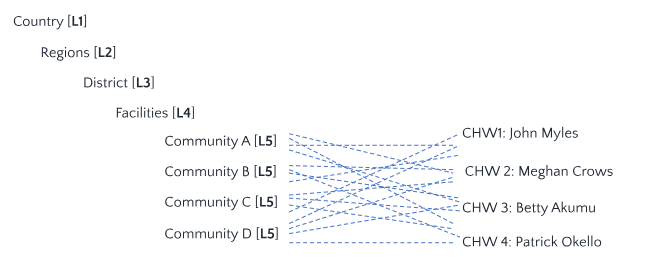
This option assumes a scenario where one or more CHWs are assigned to a single community structure under a health facility, without any overlapping of communities by CHWs. In this structure, each CHW is expected to submit their individual report for a reporting period. This setup ensures that the data collected is attributed to the specific CHW and corresponds to a particular community without mixing up, the CHW is assigned to their own organizational unit, which represents the lowest level in the hierarchy. Consequently, they will only have access to the data they have personally collected. Aggregating the data at each level will enable the accumulation of information at the levels starting from the CHWs, Communities, facilities, regions and national level. For this option, datasets would be attached at the CHW level as outlined in the hierarchy structure below:

Option 3: CHW works in several communities that is not shared by others
This option assumes a scenario where a single CHW is responsible for serving multiple communities within a health facility, without any overlap of communities by CHWs. In this structure, each CHW is required to submit individual reports for each of the communities they support. This ensures that the data is attributed to the specific community where it was collected and belongs explicitly to the assigned CHW.
Each CHW will be assigned to their own organizational unit at Level 5 in the hierarchy. They will have access to the data that belongs to their organization unit and its children at Level 6. In this case, the children refer to the communities in which the CHW operates. Consequently, the CHW can only access data that they have personally collected. And this data can be aggregated at each level; village, CHW, facility, region and national levels. For this option, datasets would be attached at the Community level as outlined in the hierarchy structure below:

Option 4: CHW as category Option attributes
In this scenario, CHWs have the flexibility to work in any community, and there may be instances where multiple CHWs serve the same community. However, each time a CHW submits a report, regardless of the community they served, it can be attributed to that specific CHW. This is achieved by utilizing category options, which allow for the creation of a list of CHWs that can be generated as a category combination and attached to the datasets. The hierarchy structure will include communities where the dataset is attached, but not the CHWs. Sharing options can also be set to enable users to access only the options assigned to them, reducing errors in data capture. Data can be captured at the Community level, and a relationship can be established between the data and the CHW using the CHW Category as a filter. Data can be aggregated at each level; community, facility, region and national levels. The data can be disaggregated by CHW by utilizing the Category as a filter, allowing for a breakdown of data specific to each CHW.
NOTE: It's important to note that this configuration may not be scalable for large CHIS with a substantial number of CHWs.
Pracovní postup
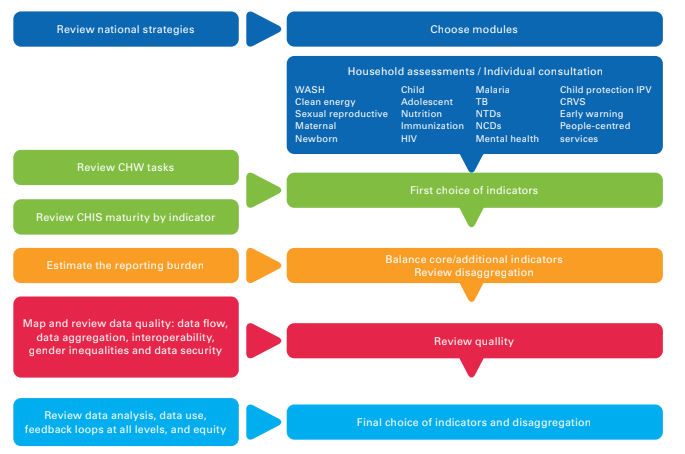
Typy služeb, které komunitní zdravotní pracovníci poskytují v komunitách, jsou mezi zeměmi vysoce heterogenní. Každý modul obsahuje seznam standardizovaných ukazatelů, které mají být přezkoumány, přizpůsobeny a přijaty podle funkcí CHW ve zdravotním systému země, zátěže jejich práce a vyspělosti CHIS. Pokyny WHO/UNICEF navrhují vícestupňový přístup pro mapování národních strategií a identifikaci modulů/ukazatelů potřebných pro monitorování a hodnocení aktivit komunity, jak je znázorněno níže:
Předpokládaní uživatelé
Balíček byl vyvinut s ohledem na následující uživatelské profily:
- Národní a subnárodní programoví manažeři zodpovědní za analýzu dat a monitorování výkonu
- Okresní manažeři a nadřízení zodpovědní za řízení a monitorování komunitních aktivit
- Komunitní zdravotničtí pracovníci poskytující zdravotní služby, provádění komunitních hodnocení, shromažďování a hlášení dat o komunitních zdravotních aktivitách
User groups
V rámci konfigurace balíčku byly vytvořeny skupiny uživatelů, které se používají ke správě nastavení sdílení v metadatech pro všechny moduly. Mezi základní metadata, která používají tato nastavení sdílení, patří zejména datové sady, řídicí panel, indikátory a datové prvky. Mezi 3 vytvořené uživatelské skupiny patří:
- Správce CHIS – uživatelé v této skupině mají přístup k zobrazení/úpravám metadat a přístup pouze k zobrazení datových hodnot v souborech dat
- Přístup CHIS – uživatelé v této skupině mají přístup pouze k metadatům a hodnotám dat v sadách dat
- CHIS Capture – uživatelé v této skupině mají přístup pouze k zobrazení metadat a přístup k zobrazení/úpravě hodnot dat v sadách dat
I když je důležité tyto userGroups při instalaci tohoto balíčku udržovat, můžete je zkontrolovat v souladu s jakýmkoli existujícím nastavením nebo zásadou userGroups v instanci hostitele.
Facility-Community integration
When adopting this package, it is crucial to consider integration of CHIS and HMIS data. The integration requirements and needs will vary depending on the existing implementations: databases may already be integrated but different datasets for both CHIS and HMIS data or databases may be separate. Alternatively, CHIS could be tracker domain while HMIS is aggregated data and it is also possible that HMIS or CHIS may use other software platforms other than DHIS2. Each of these scenarios presents unique complexities for integration. For this metadata package, we recommend two approaches for the integration: composite indicators and using the data exchange app as explained in the sections that follow.
Configuring Composite Indicators
Composite indicators involve creating indicators that utilize data elements from both the CHIS and HMIS sources. This approach enables a comprehensive view, triangulation and supports seamless routine data analysis of the entire health information. While the HMIS dataset primarily focuses on data collection at the facility level, the CHIS metadata package is specifically designed to capture and analyze a core set of indicators for community-based health services.It is important to note that both the aggregate HMIS and CHIS packages cover similar health areas, such as HIV, TB, Malaria, nutrition, EPI, and NCD, among others and these often share common data elements and indicators. When both the HMIS and CHIS packages are installed in the same instance, it becomes possible to develop composite indicators for these shared data elements across the system. As illustrated in the table below, simple output indicators can be created, and it is also possible for coverage indicators at sub-national levels. However, caution should be taken when determining the denominators, especially if communities overlap and extend beyond sub-national units. Failure to consider this may result in inaccurate estimations of coverage for the composite indicators. Also to ensure meaningful analysis, the period of data collection should be aligned to cover a complete period for both sources. Additionally, data quality control measures and checks should be in place to minimize double reporting at both the facility and community levels as it likely to occur
Below are some of the examples to learn from and create additional composite indicators as this CHIS package is adopted. Feel free to utilize these examples as a reference and explore more composite indicators as you incorporate the CHIS package into your data analysis workflows.
Table 1: Examples of possible composite indicators for some the programs in CHIS.
| Program | Facility + Community = Numerator | Jmenovatel | Example of Composite indicators |
|---|---|---|---|
| TBC | [New, relapse and cases with unknown treatment history] + [CH128b - Notified TB cases] in the catchment area] | Nedostupné | Notified TB case at facility and community |
| HIV | [HIV - HIV tests performed] + [CH028b - HIV tests returned] | Nedostupné | HIV tests performed at facility and community |
| Malárie | [MAL - Malaria suspects tested (RDT)] + [CH119a - Febrile cased tested by RDT] | Nedostupné | Malaria cases tested with RDT at facility and community |
| [MAL - RDT positive malaria cases] + [CH121 - Confirmed malaria cases] | [MAL - Malaria suspects tested (RDT)] + [CH119a - Febrile cased tested by RDT] | Malaria RDT positivity rate in facility and community(%) | |
| NUT | [NUT - Receipt of iron containing supplements antenatal care contacts in facility] + [CH037 - Women given iron supplements during ANC] | Nedostupné | Women given iron supplements during ANC at facility and community |
| [NUT - Vitamin A supplement 6-59 months routine in facility] + [CH061a - Children (6-59m) given Vit A in semester 1&2 - routine] | Population of Children (6-59m) | Children (6-59m) given Vit A at facility and community |
Using Data Exchange
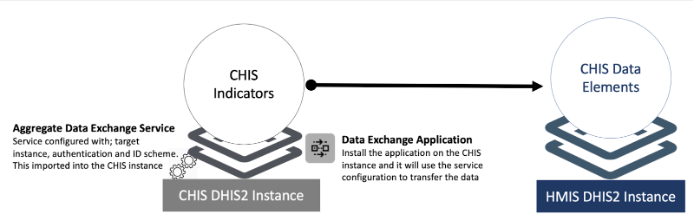
Considering a scenario where the CHIS package is installed on a separate instance from the HMIS, or even within the same database but different data sets, an aggregate data exchange service and the exchange application can be used to facilitate moving data between CHIS and HMIS platforms. Thus service and application have been introduced in the DHIS2 version 2.39 which requires the source instance of DHIS2 to be version 2.39 or later, while the target instance should be version 2.38 or later. With the assumption of separate instances for CHIS and HMIS, it is therefore possible to set up the service, install and use the application to transfer data between the instances as illustrated in the figure below. Once the CHIS data is moved into the HMIS instance, you can also create composite indicators as detailed in the previous section of this guide. Below are some the steps to follow while setting up the service:
1) Update the metadata (indicators) in the source instance (CHIS) whose data requires exchange. It is important to ensure that these indicators have metadata codes that will enable successful data exchange. 2) Update the metadata (data elements) in the target instance (HMIS) to align with the source metadata. This involves establishing similar codes in the target instance's metadata to match the code ID scheme used in the source instance. Note that the current exchange service only supports data elements without categories or non-disaggregated data. 3) Create the data exchange payload in JSON format. This payload should include all the necessary configurations for the setup, including information about the target instance, authentication requirements, and the ID scheme to be used. Once created, this configuration should be uploaded into the CHIS instance. 4)Install the data exchange application available in the DHIS2 App Hub within the CHIS instance. This application will enable the movement of data from the CHIS instance to the HMIS instance using the configured settings and payload.
Poděkování
Balíček CHIS byl vyvinut ve spolupráci s UNICEF a WHO s podporou Globálního fondu pro boj s AIDS, tuberkulózou a malárií.
Reference
Analysis and use of community-based health service data. Guidance for community health workers, strategic information and service monitoring.. March 2021. Published by United Nations Children’s Fund (UNICEF)
Pokyny pro komunitní zdravotnické informační systémy DHIS2. 2017. Program zdravotnických informačních systémů University of Oslo
Aggregate data exchange. 2023. University of Oslo, Health Information Systems Programme
Sustainable CHIS DHIS2 Design and Architecture. 2022. University of Oslo, Health Information Systems Programme